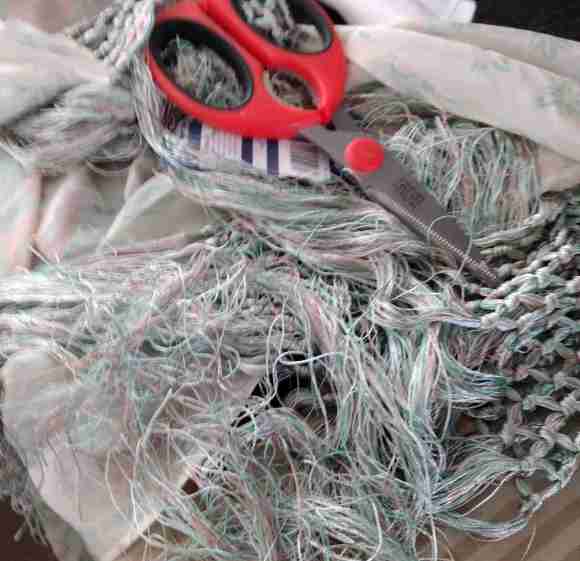
Now and then the UK charity shops are just amazing. I was browsing them this rainy morning in Bristol and found, in one shop four huge cotton scarfs in plain colours for just £2 each. Another one was just demanding to be used for doll-making, plaits and braids ready-made. All in good condition, as new. Now I’m reluctant to cut them!
Almost all the pieces in the Meltdown series are reworked from earlier fabric work, I don’t throw much away. I try to avoid polyester but for shine it does get into the mix. Rayon (viscose) thread and cloth can be shiny and I use that where I can, although rayon sewing thread is usually thinner and therefore weaker than cotton or polyester, I don’t know why that is. Silk is best but pure colour scraps can be hard to find. Viscose in clothing is often silky and now frequently used for fast-fashion clothing, also used in place of cotton, it was developed in the 19thC as a substitute for silk but has many other uses. Being made from wood pulp it’s potentially an organic fabric but the manufacturing process is intense and involves a number of chemicals. As with bamboo fabric – also viscose – there may be potential for a more environmentally friendly manufacturing process.
There’s a long way to go in creating truly eco-friendly fabrics but hopefully manufactures will be motivated by the prospect of reducing costs as well as saving the planet. Recycling of viscose clothing is low at present, a large amount go to landfill.
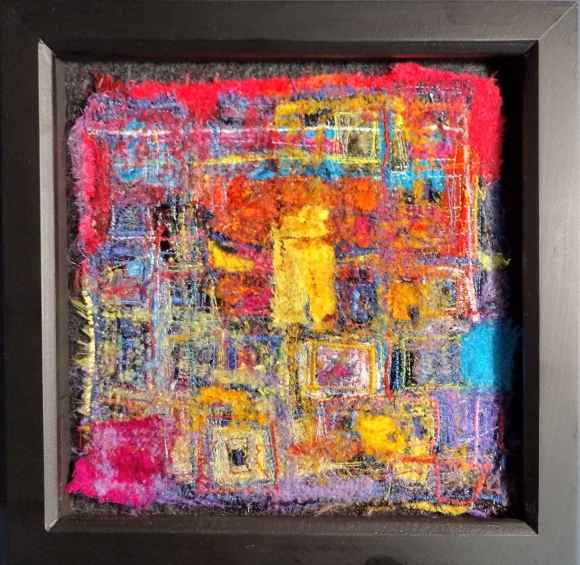
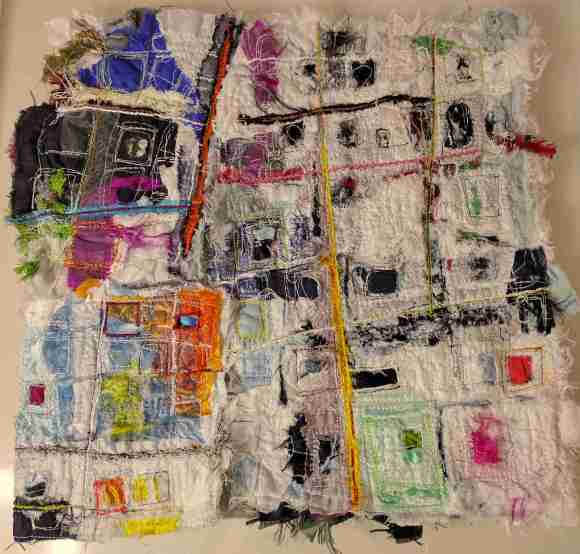
City Sunset, Mixed textiles, 20x20cm, 2024.
I was not planning to name the smaller pieces but this one seemed to name itself. All these works are for sale, at a range of modest prices direct from me or via Artigo, Gloucester Road, Bristol.
A larger-than-most piece in this series and one I’m happy with, scraps of fabric embellished and stitched, repeatedly. All the work in this series is heavily and repeatedly cut during the making, so as to expose layers of cloth and stitch. The deep box frame came with a rather wide mat/mount so I had a new one made barely 2cm wide. The black box seems to work well with these heavily textured pieces.
East Wind, Mixed textiles, 35 x 35 cm, 2024
As usual the pic doesn’t show the metallic threads or fabrics, or the stitch detail, much higher pixel count is needed for that. I was thinking about the convention in western visual art to read the work from upper left to lower right and how to try and challenge that in a small way. Keeping an idea in mind helps me focus on what I want the work to look like although I might not have a fully formed mental picture of the final result. The whole series could be described as abstract expressionism I think, if one needs labels, made trying to keep the emotion through colour to the fore. The East is Red (somewhat topical again) was in my mind while I was working on it.
Artigo, a lovely art gallery and shop on Gloucester Road, Bristol has a full set of my toy and model kits on sale and has a display of working samples which I’m told by proprietor Diego are popular with children and entertain them while adults are shopping.
Diego has kindly agreed to display for sale some of the textile art pieces I have loosely designated the Meltdown series. These are mostly quite small, colourful and heavily textured, I have named the larger pieces.
Artigo, 20.02.24
I’ve mounted these works in box frame without glass, as with impasto painting the texture is lost under glass. I used different sizes of mat at the front of the box frames (cut by Craftworks, Gloucester Rd, Bristol).
One day I might get around to trying to sell some of these pieces, but in the meanwhile I’m enjoying working on them. Netflix have recently released an intriguing documentary about the 1979 Three Mile Island ‘partial’ (wikipedia) meltdown in Pennsylvania, a then brand-new plant that the makers knew had ‘issues’. Needless to say no executives of the companies concerned suffered in any legal way.
The use of the word ‘partial’ by Wikipedia referring to this incident is telling, a ‘complete’ meltdown would supposedly lead to the remains of the fuel – after various explosions, widespread contamination etc. – burning down through the earth towards China (China Syndrome) although in reality when the corium (the mix of fuel and support structure) hit the water table the entire mess would likely explode repeatedly and spread devastation across a huge area. The documentary makes clear that the incident was 30 minutes away from a catastrophe similar or likely far worse than Fukushima.
Wikipedia also repeats the word ‘accident’, where ‘incident’ is appropriate thus helping to disguise the fact of the cover-up of known problems before the plant opened.
Unlike the Fukushima meltdowns there wasn’t much to see at Three Miler Island mainly because likely hydrogen explosions didn’t happen, more by luck than anything else.
The hundreds of nukes operating around the world have no long-term storage for their ultra-long-term poisonous, highly radioactive waste, many of them are ancient, metal fatigued, rusting and dangerous. Some, like Diablo Canyon, California are all this and sit on earthquake fault lines. All are capable of bringing cataclysmic destruction to their regions and far beyond.
In December 2023 the California Public Utilities Commission approved a proposal to keep Diablo Canyon’s twin reactors online, overturning an earlier agreement to close the plant in 2025. I have not heard anyone say that this plant could withstand a tsunami, although a large earthquake in the region is considered to be overdue. California had 7,339 earthquakes in the past year, I don’t know how that compares to other places.
I wish I had the artistic skill to reflect the mayhem and hubris of nuclear power and all it represents.
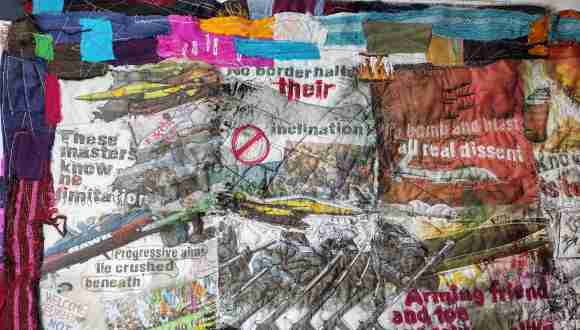
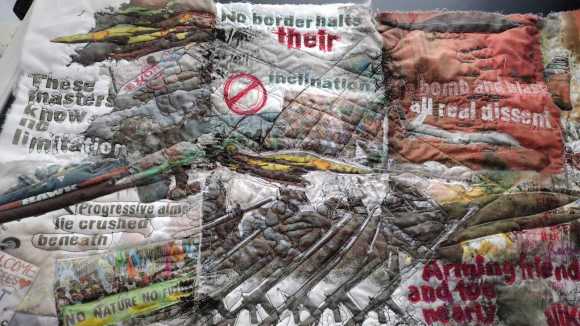
The Oil quilt consists of four panels made up of about 80 squares of 20 x 20 cm, printed, painted, drawn, embellished, stitched and embroidered in various ways. I’m finding it hard to finish, the desire to add more detail is strong but almost certainly misguided. Better to work on another piece I think.
Oil quilt, detail, approx 70 x 35 cm
This detail is from the upper left of the second panel, it feels topical. The quilt as a whole seems to be a polemic.
Oil quilt detail, approx 70 x 35 cm
This second detail is from same panel, lower right.
For the first time in several years I thought I might send some seasonal greetings cards. Lots of scrap material and lots of thread awaiting a little effort, as well as plenty of card and dance paper, so here we go. My favourite animal will be the theme, the much persecuted hare, in winter costume.
Embellishing scraps of fabric is fun, but the embellishing needles have become rather costly at around £3 each – they break easily. So it’s important to take care using the embellishing machine, needles move fast but fabric movement must be slow. I also use embellished fabrics for doll costumes.
Once the fabric is available I cut the hares out and began stitching, might have been easier to stitch first then cut out. Hand stitching is kept to a minimum, whiskers and a little finishing. Anyway the results are just about ok, I think.
Winter Hare cards, work in progress (2)
I printed some text onto hand-made paper as a backing for the fabric hares, printed a greeting on A4 card with a small name label on the reverse. Once the hares are complete I stitched them onto the backing paper, then glue the whole piece to the card.
Winter Hare cards, work in progress (1)
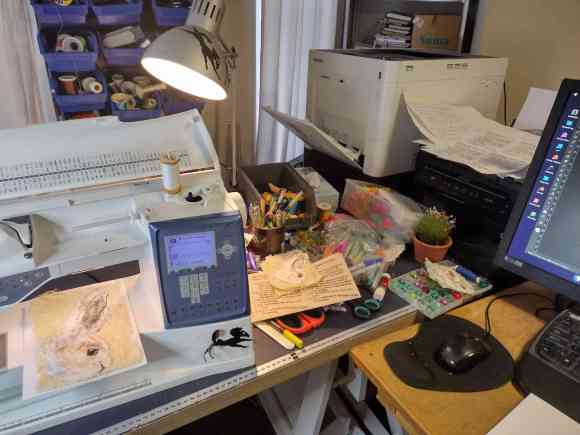
I work with both the printers – one laser and one inkjet – the mac computer, a Husqvana/Viking sewing machine, an embellishing machine and many threads, pens, fabric scraps etc. and with music playing, often BBC R3 classical. The pics show the dry work area, I’ll be gluing elsewhere.
For anyone who cares about their fellow human beings in Gaza, nothing is more important at this moment than to speak out.
Israel and its allies are trying to build a wall of silence around their devastation of Gaza. Around the world, those who seek to break through it are having to contend with an extraordinary and shameful campaign of pressure and threats. No-one who speaks out, from the UN Secretary-General to a London tube-driver, is exempt.
Yet the breakthrough has happened. In every sector of society people horrified by the attack on Gaza are speaking out. The huge demonstrations in the major cities of the world reflect the strength of public feeling.
Among cultural workers, we have seen an outpouring of solidarity, and resistance to attempts to undermine it. Here are just a few examples, from Britain and the US.
1. Thousands of visual artists and curators signed an open letter published in Artforum magazine that expressed solidarity with the Palestinian people and called for an urgent ceasefire in Gaza. A behind the scenes campaign by a number of powerful art dealers and collectors aimed to pressure individual artists to retract. A week later, the magazine’s owners fired its editor, David Velasco.
“I resent these cowardly bullying and blackmail campaigns to distract everyone in the art world from the central demand of the letter, which was: cease-fire!”
Firing Velasco did not stop the movement. Velasco responded, saying, “I’ve no regrets… I’m disappointed that a magazine that has always stood for freedom of speech and the voices of artists has bent to outside pressure.” The next day artists Nan Goldin and Nicole Eisenman announced they would no longer work with Artforum. Eisenman, who currently has a solo exhibition at London’s Whitechapel Gallery, said: “I want to echo what activists have been yelling in the streets: Not in my name. This war will not be done in my name. I resent these cowardly bullying and blackmail campaigns to distract everyone in the art world from the central demand of the letter, which was: cease-fire!”
Nearly fifty Artforum employees and contributors have now signed a letter demanding that Velasco be reinstated, saying his termination “carries chilling implications for Artforum’s editorial independence”. And three senior members of the editorial team have resigned in protest saying the firing is “unacceptable”.
“I have no regrets about anything I have said or done in regards to Palestine, Israel, or the occupation and war.”
2. Separately, nearly 800 writers signed an open letter published in the London Review of Books warning of “grave crimes against humanity” and calling for an immediate ceasefire. Last week, New York’s premier cultural centre the 92nd Street Y decided to abruptly cancel a scheduled reading by one of the letter’s signatories, Pulitzer prize-winning author Viet Thanh Nguyen.
Following the cancellation, the director and programming staff resigned their posts. The rest of the 92nd Street Y’s poetry reading season has been “put on pause” following withdrawals from other writers. Viet Thanh Nguyen, who relocated his reading to a new venue, said in a statement: “I have no regrets about anything I have said or done in regards to Palestine, Israel, or the occupation and war.”
“There’s an atmosphere that is wholly intolerant of any expression of sympathy for Palestinians living under occupation, any discussion of the root causes of the conflict.“
3. In London, the launch for Nathan Thrall’s book ‘A Day in the Life of Abed Salama: A Palestine Story’ at Conway Hall was cancelled at short notice following a ‘recommendation’ by the police. Thrall said: “There’s an atmosphere that is wholly intolerant of any expression of sympathy for Palestinians living under occupation, any discussion of the root causes of the conflict. … For events around that sort of a book to be cancelled… is outrageous.”
4. A couple of weeks later a long-planned London event organised by Palfest, the Palestine Festival of Literature, was cancelled by its host, the Royal Geographical Society. But the event found a home at the National Education Union, where hundreds packed the auditorium to listen to Soweto Kinch, Tamim al-Barghouti, Harriet Walter, Julie Christie and others.
“Hunting for a particular combination of words in every single piece of writing – no matter its focus – is a strategy. The goal is not to fight antisemitism. It’s to make people fearful to speak up against Israel’s ongoing genocidal violence for fear of being fired/smeared”. Naomi Klein, October 28th 2023
The intimidation and suppression faced by Velasco and numerous artists are incomparably less brutal than that suffered by Palestinians for generations. Palestinians, as Naomi Klein wrote today in her powerful rejection of “McCarthyite censorship”, are paying the highest price and have done for decades. Attempts to silence protesting voices in other countries are nonetheless part of the ongoing attack on the Palestinians in Gaza, in the West Bank and beyond. A people deprived of solidarity, a people whose history cannot be spoken, is a people stripped of its defences. Censorship protects those who inflict violence on them.
Following Israel’s threats to Al Jazeera this week, the wife, son, daughter and grandson of journalist Wael Al Dahdouh were killed by an airstrike. Al Dahdouh’s colleague Tamer Al Misshal said, “Wael has continued to report on Israeli atrocities despite the ongoing threats against him and his family, and he’s refused to leave Gaza in order to convey to the world what is happening there. His voice will go on – that we can guarantee. All our voices will go on, and we’ll continue to cover this assault to get the truth out every day.”
As of last night, many of those voices have been silenced. Internet, cellular and landline services have been cut off in Gaza. Palestinians face a complete communications black-out amidst an unprecedented bombing campaign. Israel is seeking to separate Gaza from the world.
Silence is enabling war crimes on a horrifying scale. We refuse silence.
Most of the work for this quilt was complete months ago but current events are spurring me to finish. I’m mainly adding borders at the moment but there will be more work after that, pens and stitch and some discharge paste to remove colour in a few places. It can be hard to know when to stop! The original poem was written long ago, it’s on this site in artist’s book form.
Anti-art was a term adopted by the COBRA group of artists who formed in Copenhagen, Brussels and Amsterdam in 1945, as WW2 in Europe ended, a reaction to the horrors just experienced. Some of their work is at the Cobra Museum of Modern Art in Amsterdam, well worth a visit if you are in that great city, I found it inspiring. The label anti-art for works that end up in art galleries is a good place to start a discussion about what is art (yawn) because as soon as a gallery is involved or the works are sold then it must become art of some sort. Perhaps if they had kept the work to themselves the group would have been labelled as producers of Art Brut, a form which doesn’t seek public approval or sales, generally.
There is a documentary currently (October 2023) on BBC iPlayer about the Dada movement, closely associated with anti-art.