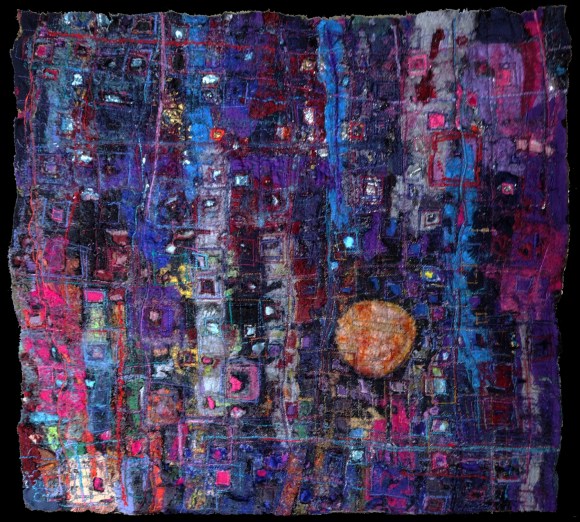
Here are a few more in the City series, all completed this year. All the City series are deeply textured, and with a light fabric medium finish to protect the surface, not under glass.
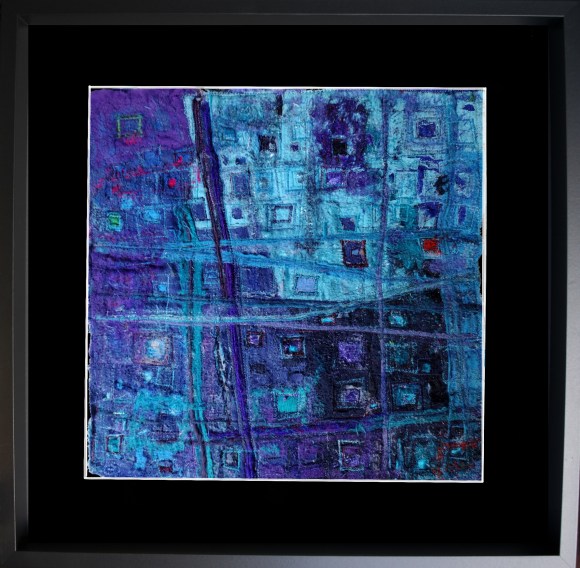
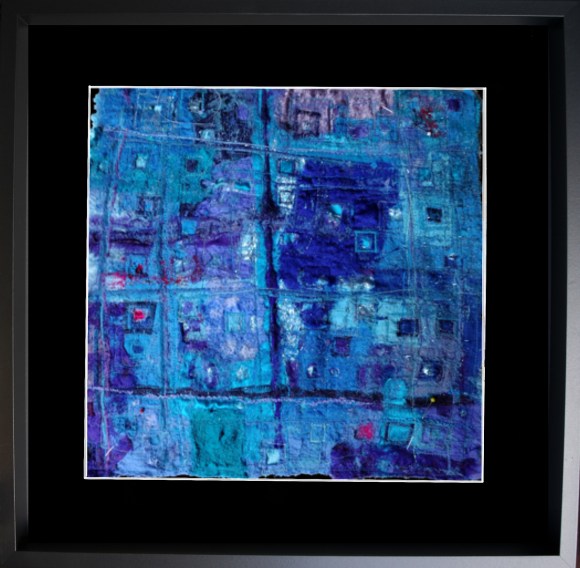
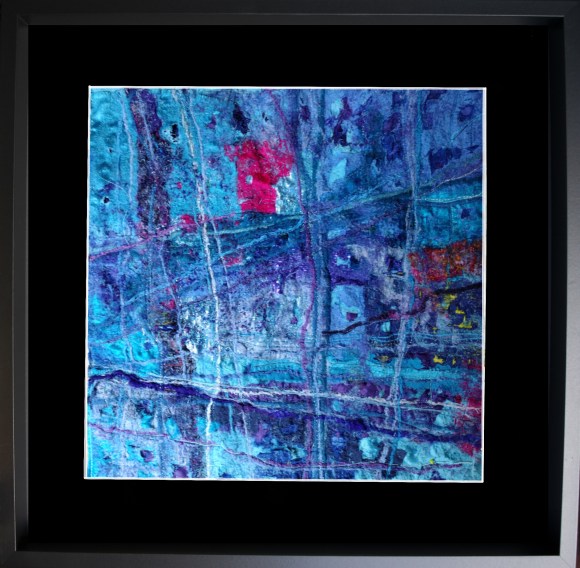
Here are a few more in the City series, all completed this year. All the City series are deeply textured, and with a light fabric medium finish to protect the surface, not under glass.
I have several new pieces of textile art in the series I called City, just going to the framers Craft Works, Gloucester Road, Bristol. These are mixed textiles, embellished, embroidered and stitched. These works are in box frames that are deeper and darker that shown here.
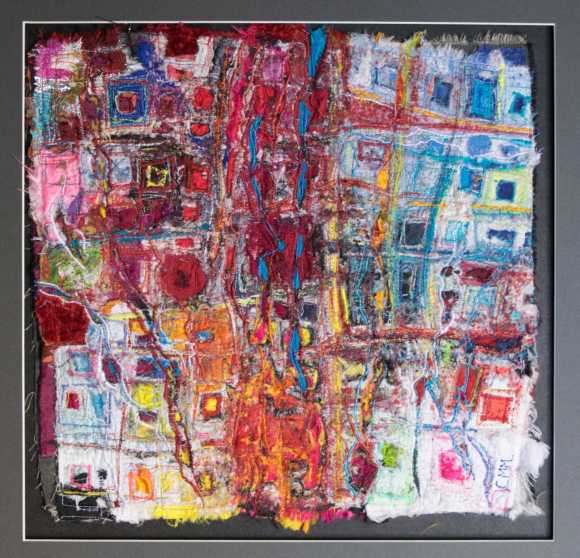
Most years I manage an outing to the Fashion + Textile Museum in Bermondsey where the shows are always top notch. Nearby is the rather more famous White Cube Gallery, currently featuring American artist Lynne Drexler (1928–99) and others, which makes for an enjoyable trip especially if followed by lunch at Borough Market.
At the moment the FA is showing’ Outlaws: Fashion Renegades of 80s London, “Centres around the legendary nightclub Taboo, opened by designer and performance artist Leigh Bowery in 1985”.
They host workshops and one coming up which caught my eye is by the wonderful textile artist Holly Searle aka The Subversive Stitcher.
“Working on vintage tea towels, Holly will take you through the processes of selection and customisation to help you effectively communicate your ideas. Using simple hand stitching and applique techniques, participants will add text to their designs as Holly speaks about her own design practice and her ongoing project, The Subverted Vintage Tea Towel Series.”

In the distant days of 2011 when President Obama was ‘surging’ on Afghanistan, continuing the US invasion and occupation, there was yet another drone strike on a celebration gathering and the usual denial/excuses were dribbled into those few sections of the corporate media who were slightly interested in the fate of ‘natives’. The US military refers to those places it invades as ‘Indian Territory’ and any opposition – real or imagined – as ‘hostiles’, the same terms in use when the native peoples in the Americas were being destroyed by Europeans mainly originating from Britain. It frequently names its weapons and procedures using First Nation names, e.g. Apache ground attack helicopters. I’m reminded that the current mass slaughter of Arabs by the western proxy state apartheid israel is just the latest round killing, destruction and impoverishment of much of West Asia by the USA and it’s allies such as the UK.
Anyway I was prompted to draw and then later work on those drawings, in textiles and other media such as the enamel piece on this blog.
I have a few textile versions in various stages of completion but never quite finished, the one I’m posting here had a wide border I didn’t like which I removed last year, now I am adding a blue border which will be embroidered.
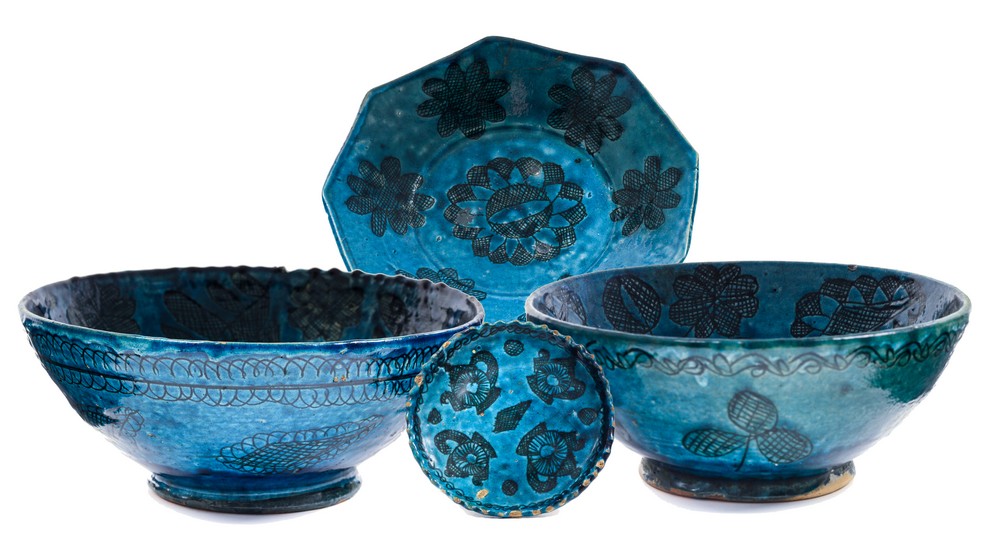
There is a guide to Istalif pottery on the Jindhag Foundation site. I especially like the motifs used to decorate this fine handmade pottery so something loosely similar will be added to the blue border using black thread and free motion machine stitch

I feel I’m finally completing this textile piece and can also now hopefully finish the other versions.
I’ve put other links about CoBrA but this is an excellent introduction to the movement written on the 75th anniversary of it’s founding, last year.
As the seeming stampede to world war by the western states and their proxies continues the political stance of the CoBrA artists is more important than ever.
A visit to the CoBrA Museum in Amsterdam is not to be missed if you find yourself in that fair city.

The spirit of the movement is anti-formalist.
The pleasure of textiles might be related to the fact we are literally surrounded by them from birth, almost instantly wrapped even before being presented to our mothers. A huge part of human endeavour is to clothe ourselves, keep us warm with bedding, cosseted with cushions. Decorative fabrics and upholstery play large parts in our lives and we expend a goodly portion of our income on all these things.
It’s thought that humans have been using clothing (skins) for at least 500,000 years but when we began decorating those clothes is not yet known. Decorative fabrics were used by ancient civilisations although examples are vanishingly rare, unlike clay pots they mostly cannot usually survive time.
The infinite possibilities of textile art offer a tempting panorama but in order to achieve anything it is necessary to restrict oneself to just a tiny fraction of that view, I think. I posted a little about making this piece last November and I haven’t found a use for it yet but I’m sure it will get used.
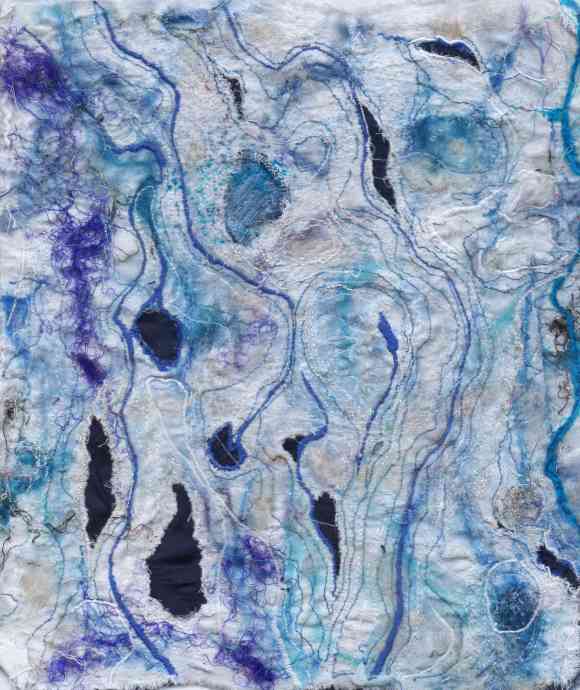
Making this I was inspired by Sarah Ross-Thompson, printmaker of renown and the photographs she often posts on Facebook.

“Rhythm in art is the visual or auditory pattern created by repeated shapes, elements, colors, sounds, and movements. It is used to create a sense of flow and connection within a work of art, as well as draw attention to certain areas of the composition. Rhythm can be achieved through repetition and variation, contrast, gradation and echo.” Studiobinder
Studiobinder – a video software house – blog has some useful definitions and practical examples of the creation and use of rhythm in video and they apply to plastic art (and other artistic ideas), most of the examples shown are painting but the same ideas apply everywhere.
In my own work I’m aware of rhythm in the flow of the stitch lines, the juxtaposition of colour and the textural depth, I use these as well as cut-away, embellish, embroider and ink. Mostly an intuitive process, based on the sketch and scrapbook but with larger pieces some planning and sketching is essential.

A short walk from my home In Bristol Studio hosts a wide range of artists and makers – what a city! – “…an artist-led studio and home to over 50 artists and makers who work across multiple disciplines.” There are classes here and occasionally expos, the BS5 Arts Trail event on September 7th and 8th 2024 will be an open studio event.

Another in this series of textile pieces, not quite how I intended but almost finished and ready to frame. the contrast around the yellow isn’t as strong as I would like but further stitching over already quite dense and layered fabric and stitch will probably mean more broken sewing machine needles.

Although most of the fabrics are plain colours I also use white and colour it in-situ, sometimes also colour white thread the same way.
Perhaps it’s time to take up painting with paint, I feel the need to get the paint on thick and then flourish the pallet knife! But in the meantime scraps of shiny fabric, threads, the embellishing machine and my recently serviced sewing machine will have to do.

The piece had quite a lot of metallic thread and shining cloth but this doesn’t show in the photo, also I have further embellished it which makes the surface matt, even fluffy. Quite a lot of the work here is cutting away, to create depth and reveals but this is contradicted by the action of machine stitching which pulls the layers of fabric tightly together. Some hand stitching now.

