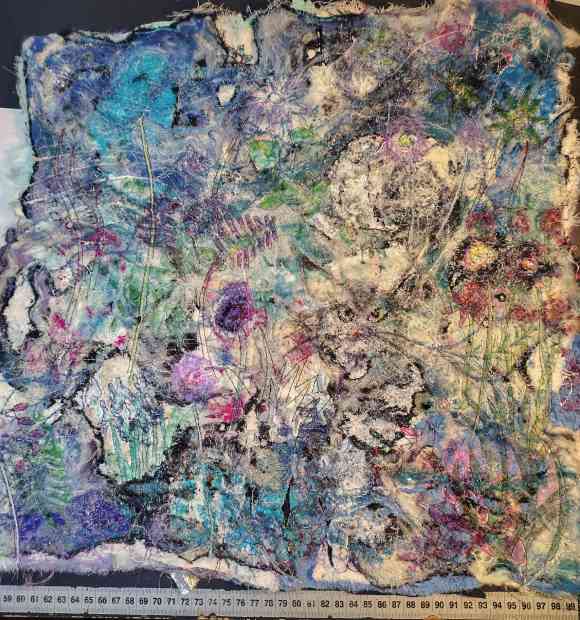
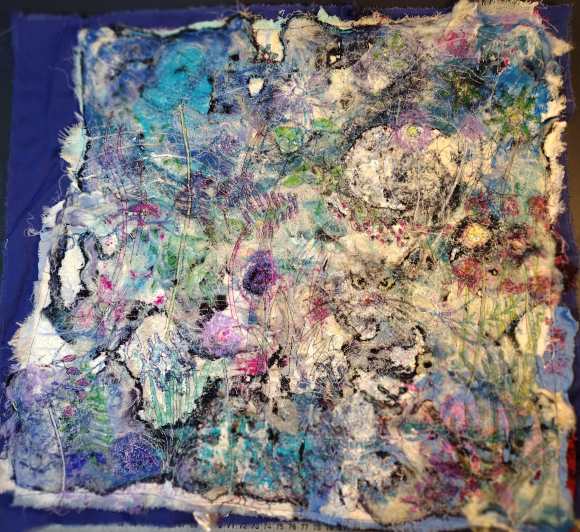
Night Garden, mixed textiles embellished and embroidered, about 50 x 50 cm
Almost finished, this piece has been hanging around for months waiting for some inspiration as to how to finish it. I tried adding a mouse but that didn’t work well. When in doubt, stitch, but now I’m afraid of wrecking what there is. The surface is rather fragile as it is mainly nunofelt with scraps of fabric below, all stitched and embellished.
One day later… I added a little more stitch, tried to reemphasise the cat but subtly then, deciding it was finished I added a backing. Next a gently wash then seal with very dilute pva. Then press and a frame of some sort.
Night Garden, approx. 50x50cm, mixed textiles embellished and stitched. 2025.
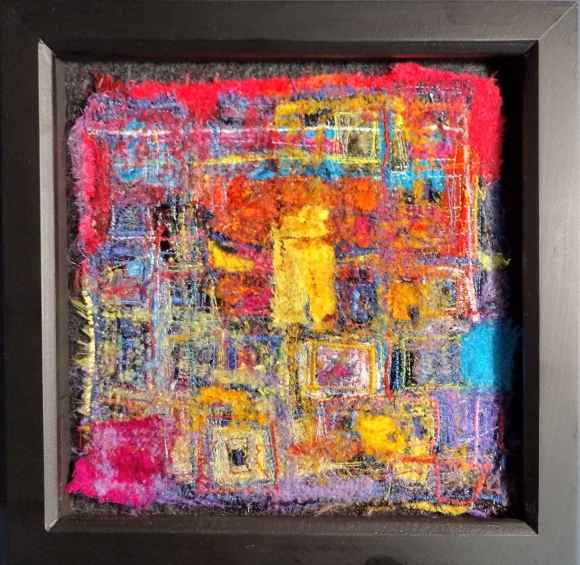
When I was making or remaking embellished work of this type a year or more ago I categorised them all as part of sets called either Meltdown or City, (1,2,3 etc) but later some of them seemed to find other names. This one is now In the Sun. Most of the pics I put on this blog or elsewhere are quite low resolution by current online standards but this one has a few more pixels.
In the Sun, mixed textiles embellished and embroidered, 25×25, box framed, 2024
It can be satisfying to take colour to an extreme.
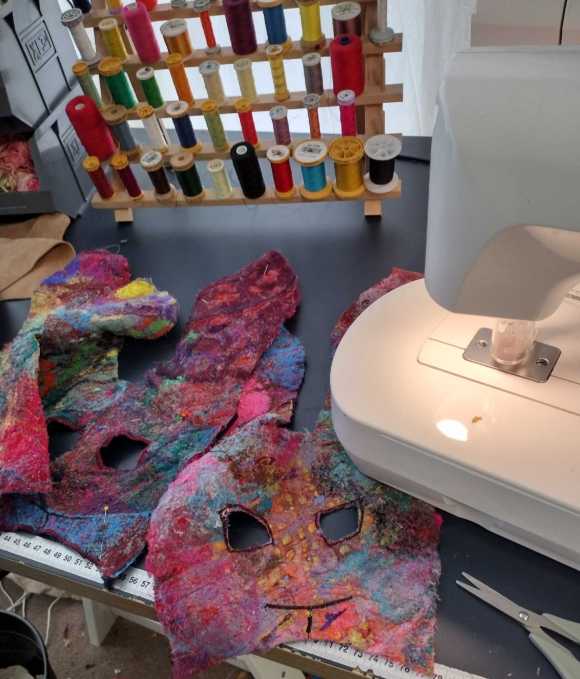
I’m waiting for the post to bring some 18g (1mm) aluminium wire to make the supporting frame for these masks, the embellished fabric in this first pic is a bit heavier than usual (lower pic) and so needs a slightly stiffer wire.
Once the fabric versions are complete, maybe five or six, I’m going to start on some leather ones, with a somewhat different set of tools although the sewing machine will still play a part.
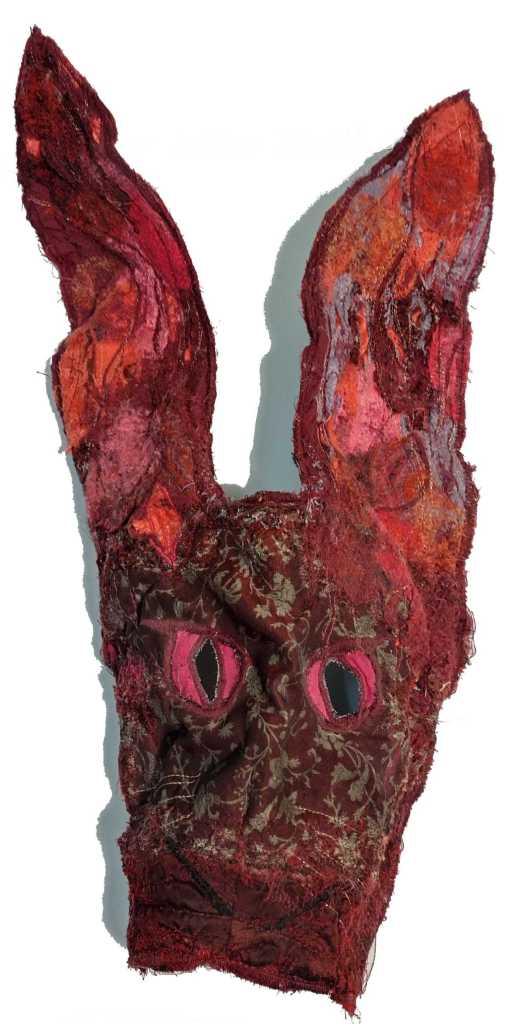
Hare Mask 2, mostly finished
Mostly finished and mostly a trial for the shaping and finishing.
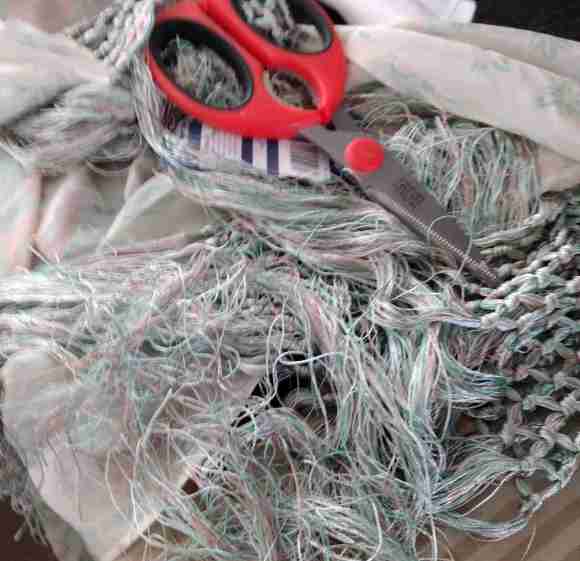
Now and then the UK charity shops are just amazing. I was browsing them this rainy morning in Bristol and found, in one shop four huge cotton scarfs in plain colours for just £2 each. Another one was just demanding to be used for doll-making, plaits and braids ready-made. All in good condition, as new. Now I’m reluctant to cut them!
Almost all the pieces in the Meltdown series are reworked from earlier fabric work, I don’t throw much away. I try to avoid polyester but for shine it does get into the mix. Rayon (viscose) thread and cloth can be shiny and I use that where I can, although rayon sewing thread is usually thinner and therefore weaker than cotton or polyester, I don’t know why that is. Silk is best but pure colour scraps can be hard to find. Viscose in clothing is often silky and now frequently used for fast-fashion clothing, also used in place of cotton, it was developed in the 19thC as a substitute for silk but has many other uses. Being made from wood pulp it’s potentially an organic fabric but the manufacturing process is intense and involves a number of chemicals. As with bamboo fabric – also viscose – there may be potential for a more environmentally friendly manufacturing process.
There’s a long way to go in creating truly eco-friendly fabrics but hopefully manufactures will be motivated by the prospect of reducing costs as well as saving the planet. Recycling of viscose clothing is low at present, a large amount go to landfill.
City Sunset, Mixed textiles, 20x20cm, 2024.
I was not planning to name the smaller pieces but this one seemed to name itself. All these works are for sale, at a range of modest prices direct from me or via Artigo, Gloucester Road, Bristol.
“A newspaper clipping glimpsed in a new documentary is headlined “New Mexico’s Infant Mortality Highest in U.S., Report Says.” Lois Lipman’s film explains why that rate is so high for babies, as well as for others, especially Indigenous and Hispanic inhabitants, in her gripping First We Bombed in New Mexico. Onscreen Tina Cordova, born and raised at Tularosa, only 30 miles from the Trinity Site, declares: “We are the first victims of the atomic bomb.””
The above is from Counterpunch+ behind a paywall, but the film First We Bombed in New Mexico is now released, to rave reviews, I hope it gets to the UK very soon. ’Thousands of New Mexicans – mostly Hispanic and Native American – were exposed to catastrophic levels of radioactive fallout, never warned, never acknowledged and never helped afterwards. Generations of cancers followed.‘
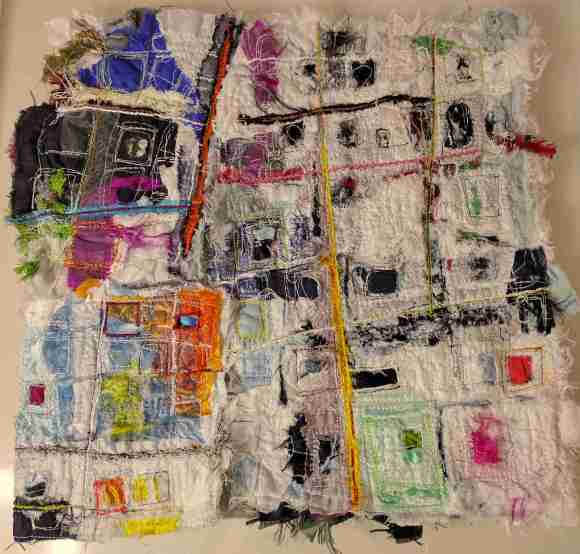
I’ve been working on several pieces in the series I’ve called Meltdown, this is the latest work very much in progress.
Work in progress – Core Melt, about 30cm sq. Embellished, quilted and stitched mixed textiles
I’ve been having a little fun finding names for the pieces instead of just Meltdown 1, 2, 3 &c. and I found, ‘No Risk to the Public’, mildly amusing. The International Atomic Energy ‘Authority’ – the trade body for the nuke industry – likes to claim that far more people have died from the evacuation and it’s subsequent effects at Fukushima than have been irradiated to death, almost as though this is proof that meltdowns are survivable. The fact that a mass evacuation might be necessary at all doesn’t seem to be an issue for them. No one ever needs to be evacuated from a solar or wind farm, biomass converter or a conventional fossil fuel power station. The corium – the many, many tons of melted fuel and containment structure are unlikely to be removed from the site before 2050, if then, because they are too ‘hot’ to handle, even for robots. Of course all that stuff will remain dangerous for thousands of years, there is no safe disposal at this time.
The number of deaths and serious illnesses from radiation released and still being released at Fukushima is disputed and could be many thousands. China, Korea and other states have banned fish from Japan.
The cleanup cost is now estimated at least $200 billion, likely far higher since every estimate so far has proven low – from one incident!
One day I might get around to trying to sell some of these pieces, but in the meanwhile I’m enjoying working on them. Netflix have recently released an intriguing documentary about the 1979 Three Mile Island ‘partial’ (wikipedia) meltdown in Pennsylvania, a then brand-new plant that the makers knew had ‘issues’. Needless to say no executives of the companies concerned suffered in any legal way.
The use of the word ‘partial’ by Wikipedia referring to this incident is telling, a ‘complete’ meltdown would supposedly lead to the remains of the fuel – after various explosions, widespread contamination etc. – burning down through the earth towards China (China Syndrome) although in reality when the corium (the mix of fuel and support structure) hit the water table the entire mess would likely explode repeatedly and spread devastation across a huge area. The documentary makes clear that the incident was 30 minutes away from a catastrophe similar or likely far worse than Fukushima.
Wikipedia also repeats the word ‘accident’, where ‘incident’ is appropriate thus helping to disguise the fact of the cover-up of known problems before the plant opened.
Unlike the Fukushima meltdowns there wasn’t much to see at Three Miler Island mainly because likely hydrogen explosions didn’t happen, more by luck than anything else.
The hundreds of nukes operating around the world have no long-term storage for their ultra-long-term poisonous, highly radioactive waste, many of them are ancient, metal fatigued, rusting and dangerous. Some, like Diablo Canyon, California are all this and sit on earthquake fault lines. All are capable of bringing cataclysmic destruction to their regions and far beyond.
In December 2023 the California Public Utilities Commission approved a proposal to keep Diablo Canyon’s twin reactors online, overturning an earlier agreement to close the plant in 2025. I have not heard anyone say that this plant could withstand a tsunami, although a large earthquake in the region is considered to be overdue. California had 7,339 earthquakes in the past year, I don’t know how that compares to other places.
I wish I had the artistic skill to reflect the mayhem and hubris of nuclear power and all it represents.
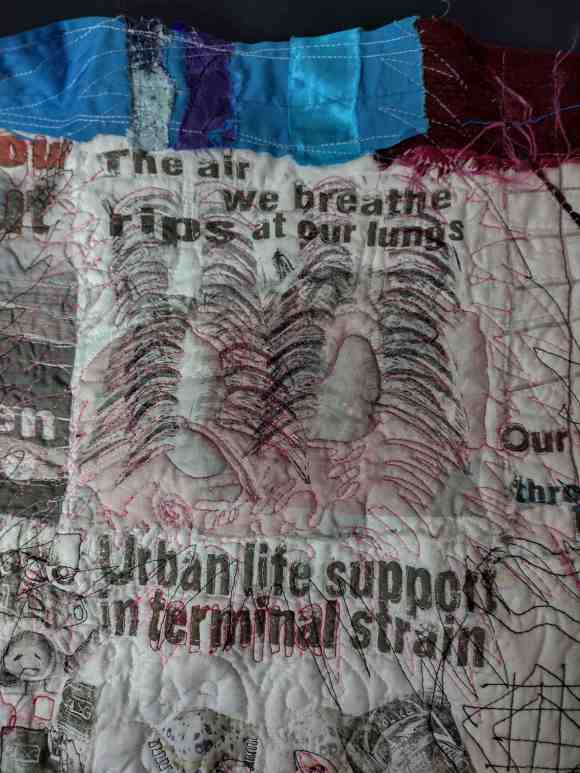
The Oil quilt consists of four panels made up of about 80 squares of 20 x 20 cm, printed, painted, drawn, embellished, stitched and embroidered in various ways. I’m finding it hard to finish, the desire to add more detail is strong but almost certainly misguided. Better to work on another piece I think.
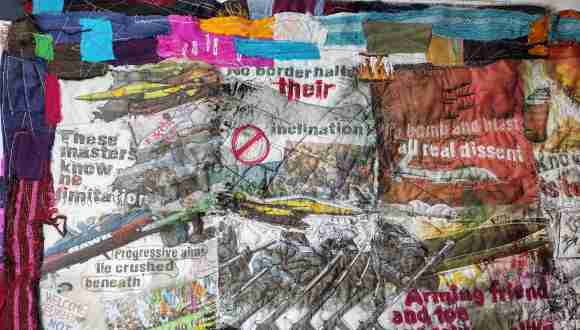
Oil quilt, detail, approx 70 x 35 cm
This detail is from the upper left of the second panel, it feels topical. The quilt as a whole seems to be a polemic.
Oil quilt detail, approx 70 x 35 cm
This second detail is from same panel, lower right.





 FlagFly