The pleasure of textiles might be related to the fact we are literally surrounded by them from birth, almost instantly wrapped even before being presented to our mothers. A huge part of human endeavour is to clothe ourselves, keep us warm with bedding, cosseted with cushions. Decorative fabrics and upholstery play large parts in our lives and we expend a goodly portion of our income on all these things.
It’s thought that humans have been using clothing (skins) for at least 500,000 years but when we began decorating those clothes is not yet known. Decorative fabrics were used by ancient civilisations although examples are vanishingly rare, unlike clay pots they mostly cannot usually survive time.
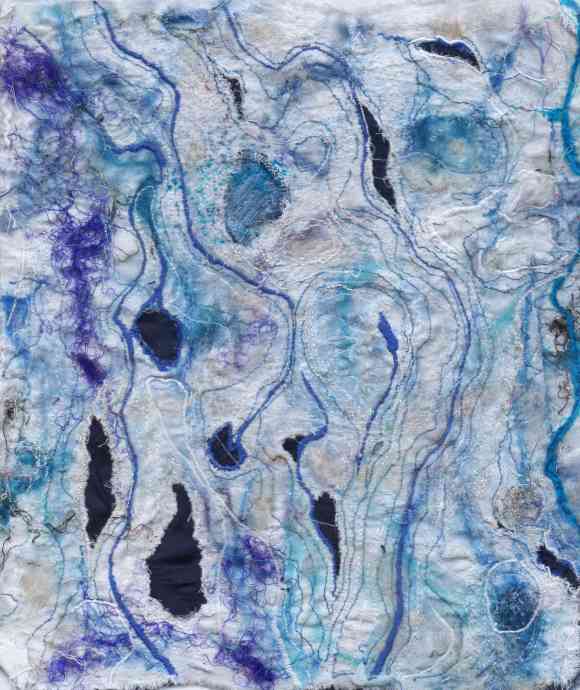
The infinite possibilities of textile art offer a tempting panorama but in order to achieve anything it is necessary to restrict oneself to just a tiny fraction of that view, I think. I posted a little about making this piece last November and I haven’t found a use for it yet but I’m sure it will get used.
Pools, 26 x 21cm, mixed textiles embellished and stitched, 2024
Making this I was inspired by Sarah Ross-Thompson, printmaker of renown and the photographs she often posts on Facebook.
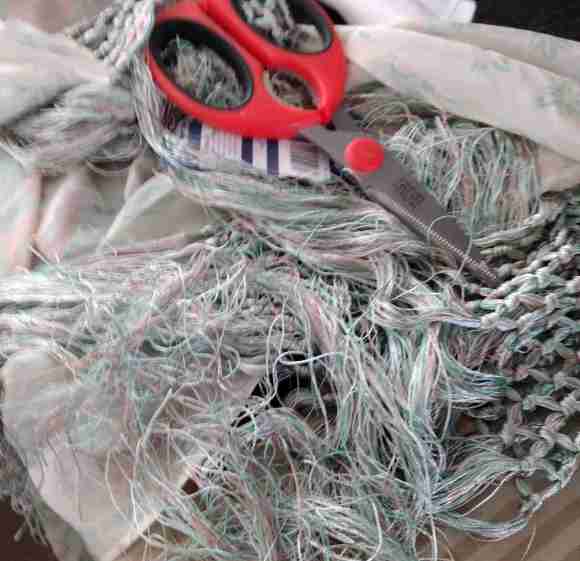
Now and then the UK charity shops are just amazing. I was browsing them this rainy morning in Bristol and found, in one shop four huge cotton scarfs in plain colours for just £2 each. Another one was just demanding to be used for doll-making, plaits and braids ready-made. All in good condition, as new. Now I’m reluctant to cut them!
“A newspaper clipping glimpsed in a new documentary is headlined “New Mexico’s Infant Mortality Highest in U.S., Report Says.” Lois Lipman’s film explains why that rate is so high for babies, as well as for others, especially Indigenous and Hispanic inhabitants, in her gripping First We Bombed in New Mexico. Onscreen Tina Cordova, born and raised at Tularosa, only 30 miles from the Trinity Site, declares: “We are the first victims of the atomic bomb.””
The above is from Counterpunch+ behind a paywall, but the film First We Bombed in New Mexico is now released, to rave reviews, I hope it gets to the UK very soon. ’Thousands of New Mexicans – mostly Hispanic and Native American – were exposed to catastrophic levels of radioactive fallout, never warned, never acknowledged and never helped afterwards. Generations of cancers followed.‘
I’ve been working on several pieces in the series I’ve called Meltdown, this is the latest work very much in progress.
Work in progress – Core Melt, about 30cm sq. Embellished, quilted and stitched mixed textiles
I’ve been having a little fun finding names for the pieces instead of just Meltdown 1, 2, 3 &c. and I found, ‘No Risk to the Public’, mildly amusing. The International Atomic Energy ‘Authority’ – the trade body for the nuke industry – likes to claim that far more people have died from the evacuation and it’s subsequent effects at Fukushima than have been irradiated to death, almost as though this is proof that meltdowns are survivable. The fact that a mass evacuation might be necessary at all doesn’t seem to be an issue for them. No one ever needs to be evacuated from a solar or wind farm, biomass converter or a conventional fossil fuel power station. The corium – the many, many tons of melted fuel and containment structure are unlikely to be removed from the site before 2050, if then, because they are too ‘hot’ to handle, even for robots. Of course all that stuff will remain dangerous for thousands of years, there is no safe disposal at this time.
The number of deaths and serious illnesses from radiation released and still being released at Fukushima is disputed and could be many thousands. China, Korea and other states have banned fish from Japan.
The cleanup cost is now estimated at least $200 billion, likely far higher since every estimate so far has proven low – from one incident!
Perhaps it’s time to take up painting with paint, I feel the need to get the paint on thick and then flourish the pallet knife! But in the meantime scraps of shiny fabric, threads, the embellishing machine and my recently serviced sewing machine will have to do.
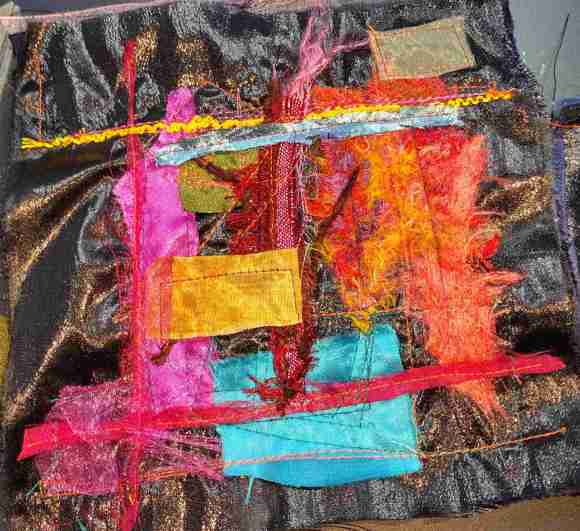
Cold Fusion 2/10 in progress, mixed textiles
The piece had quite a lot of metallic thread and shining cloth but this doesn’t show in the photo, also I have further embellished it which makes the surface matt, even fluffy. Quite a lot of the work here is cutting away, to create depth and reveals but this is contradicted by the action of machine stitching which pulls the layers of fabric tightly together. Some hand stitching now.
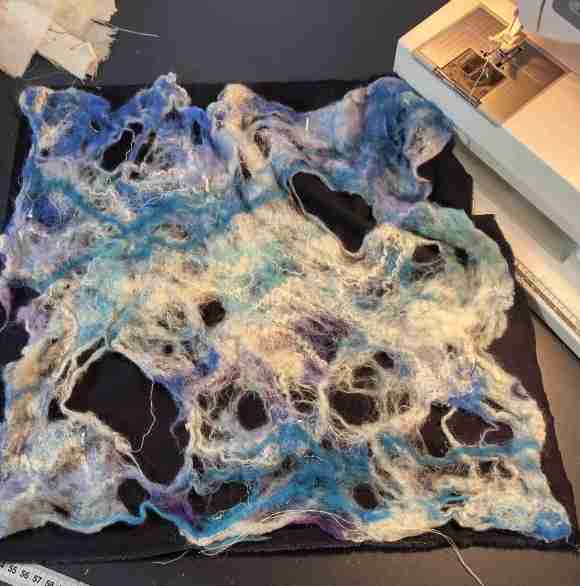
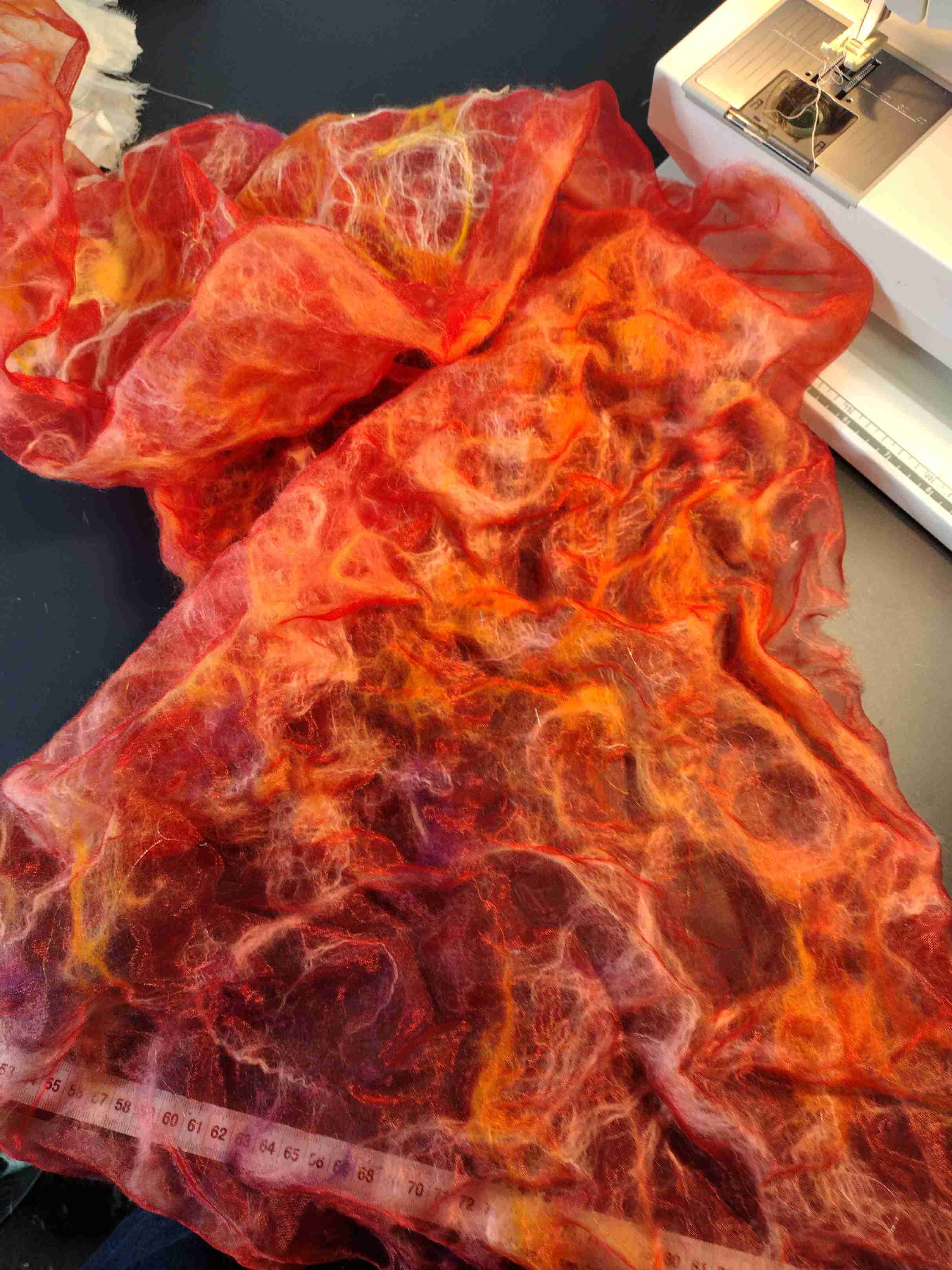
Sorting through piles of old fabric scraps I came across these pieces of nunofelt, made many years ago on my kitchen table. These are left over from some other half-forgotten project, party clothing for a friend. Now to be reworked as Meltdown Cold Fusion (lol), the blue piece …
Nunofelt on black cotton, 45 cm sq, work in progress
For the first time in several years I thought I might send some seasonal greetings cards. Lots of scrap material and lots of thread awaiting a little effort, as well as plenty of card and dance paper, so here we go. My favourite animal will be the theme, the much persecuted hare, in winter costume.
Embellishing scraps of fabric is fun, but the embellishing needles have become rather costly at around £3 each – they break easily. So it’s important to take care using the embellishing machine, needles move fast but fabric movement must be slow. I also use embellished fabrics for doll costumes.
Once the fabric is available I cut the hares out and began stitching, might have been easier to stitch first then cut out. Hand stitching is kept to a minimum, whiskers and a little finishing. Anyway the results are just about ok, I think.
Winter Hare cards, work in progress (2)
I printed some text onto hand-made paper as a backing for the fabric hares, printed a greeting on A4 card with a small name label on the reverse. Once the hares are complete I stitched them onto the backing paper, then glue the whole piece to the card.
Winter Hare cards, work in progress (1)
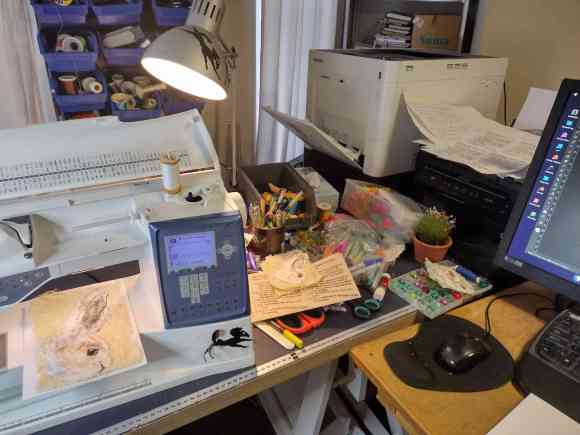
I work with both the printers – one laser and one inkjet – the mac computer, a Husqvana/Viking sewing machine, an embellishing machine and many threads, pens, fabric scraps etc. and with music playing, often BBC R3 classical. The pics show the dry work area, I’ll be gluing elsewhere.
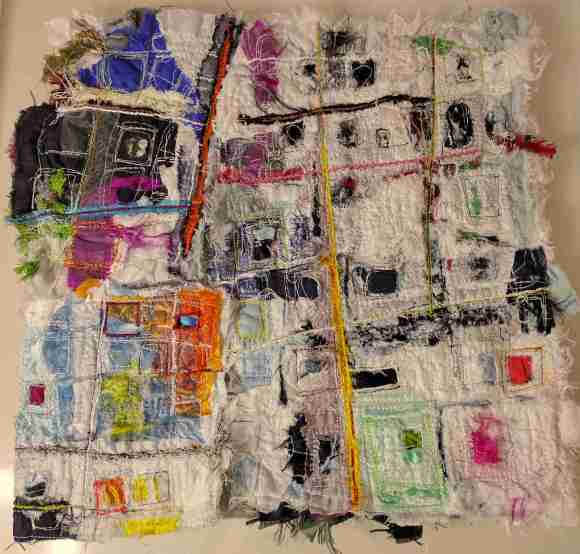
After a busy few days in London, several art galleries as well as street actions culminating in the gigantic – 800,000 peaceful folk – Palestine demo I’m doing some sewing, revising some old ideas. Meltdown, a series of fabric pieces, embellished, embroidered and heavily stitched, begun in 2015 as a response to the disaster at Fukushima (2011 on-going).
Meltdown pieces at the sewing machine, about 20 x 20 cm
The subtlety of colour and stitch is rather lost in these photos.
I enjoy creating something – maybe not beautiful but hopefully of interest – using the tiniest of scraps picked up from the studio floor or stuffed away in waste bags.
Most of the thread I use for larger pieces or clothes (rare now) is organic cotton which is a little heavier than ordinary cotton, but for this work rayon, made from wood pulp is perfectly good. Not a plug just that these are widely available, Marathon rayon threads are very low cost and although they can be a little weak for some work they have a pleasant lustre and strength isn’t an issue here.
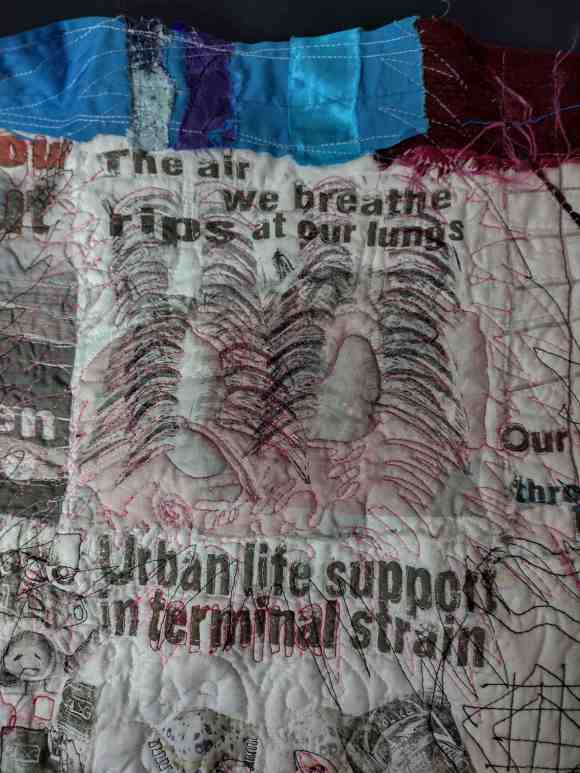
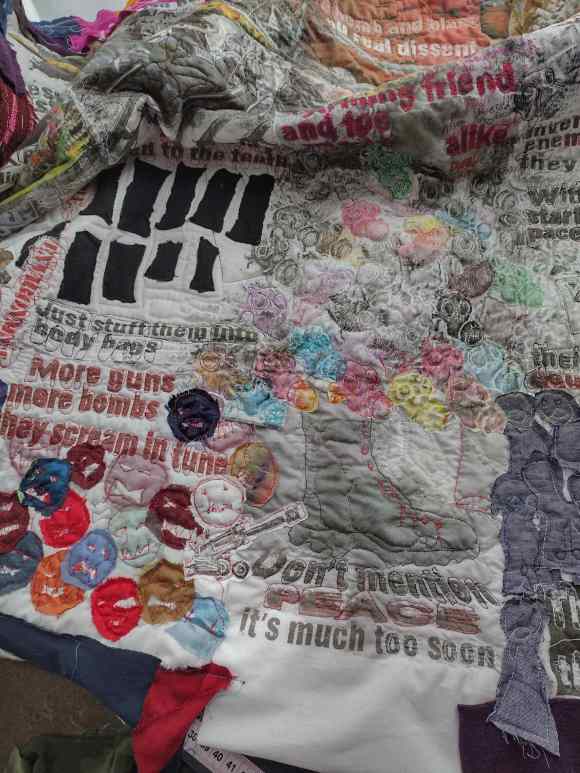
Most of this was complete months ago, just doing borders now. If the text seems topical, October 31st 2023, it’s because the people in charge in the west never stop bombing some poor brown folk somewhere in West Asia, Africa or Central America, or anywhere else they fancy.