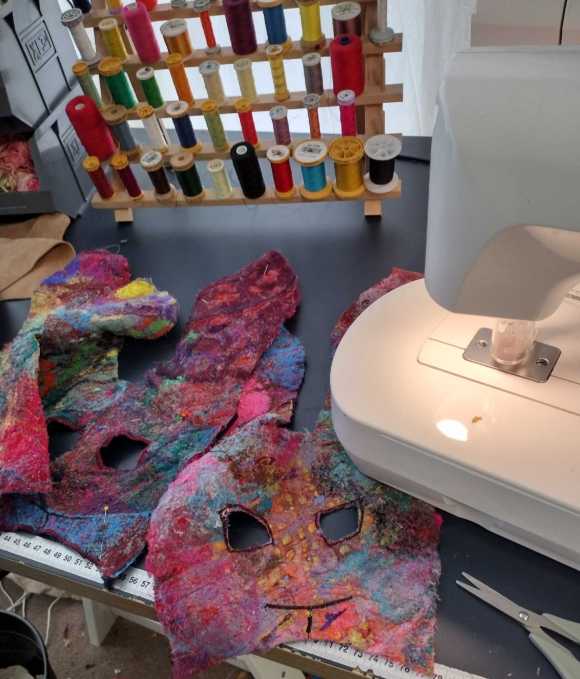
I’m waiting for the post to bring some 18g (1mm) aluminium wire to make the supporting frame for these masks, the embellished fabric in this first pic is a bit heavier than usual (lower pic) and so needs a slightly stiffer wire.
Once the fabric versions are complete, maybe five or six, I’m going to start on some leather ones, with a somewhat different set of tools although the sewing machine will still play a part.
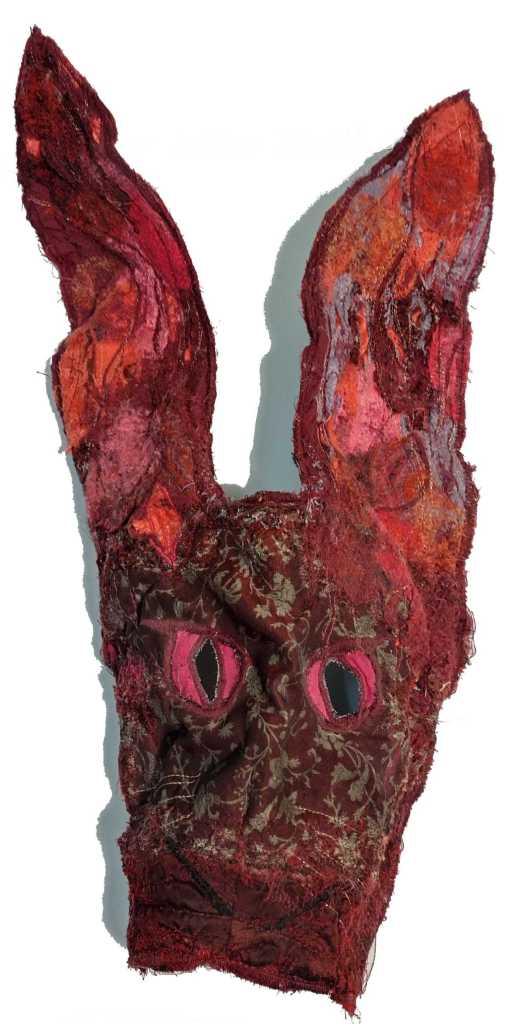
Hare Mask 2, mostly finished
Mostly finished and mostly a trial for the shaping and finishing.
Post updated October 8th 2024. This is the final version of Requiem for Oil, 270 x 165 cm, mixed textiles, lino-print, transfer & other print, stamping, ink, fabric paint, embroider and machine stitch. I delivered the quilt to 44AD gallery in Bath yesterday and it will be on display from Thursday 10th October as part of the Bath OPen Art Prize Exhibition 2024.
Art Brut (‘raw art’ or for the cupboard) I expect. But more influenced by the COBRA (Copenhagen, Brussels, Amsterdam) anti-formalism movement which grew out of Dada and the disaster of WW2.
If you’re in Amsterdam be sure to visit Cobra Museum in Amstelveen.
Another in this series of textile pieces, not quite how I intended but almost finished and ready to frame. the contrast around the yellow isn’t as strong as I would like but further stitching over already quite dense and layered fabric and stitch will probably mean more broken sewing machine needles.
work in progress – City Sunrise, 25 x 25cm, mixed textiles, embellished and embroidered
Although most of the fabrics are plain colours I also use white and colour it in-situ, sometimes also colour white thread the same way.
Another machine embroidery and embellish piece, scraps of fabric, mostly natural cotton and silk but with some poly for the shine, this is rather more whimsical than most of my offerings, the bee seems to be popular but the wings need a bit more work.
Spring Garden with bee in progress, 34x34cm, mixed textiles, machine embroider and embellish.
I’ve been finding the dust from the machine embellishing process to be annoying, even using a mask it seems to get in the throat. I now have a small air filter machine that sits on the desk, it seems to help. I also vacuum every few minutes and make sure to wash hands often. The dust is very fine, it gathers around the embellishing needles and guard but also manages to spread around the work area.
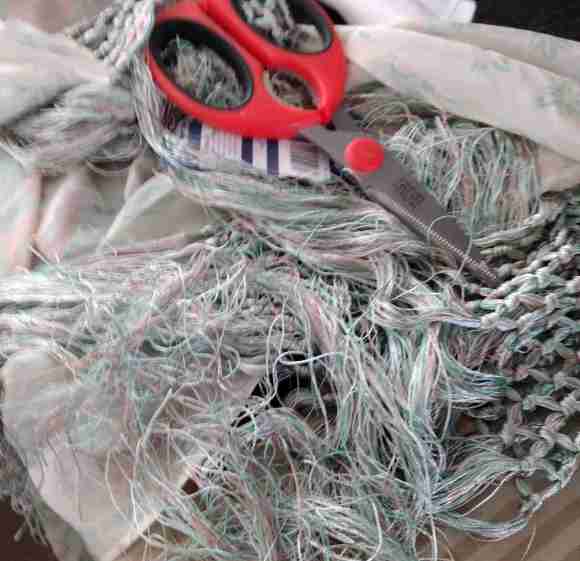
Now and then the UK charity shops are just amazing. I was browsing them this rainy morning in Bristol and found, in one shop four huge cotton scarfs in plain colours for just £2 each. Another one was just demanding to be used for doll-making, plaits and braids ready-made. All in good condition, as new. Now I’m reluctant to cut them!
Almost all the pieces in the Meltdown series are reworked from earlier fabric work, I don’t throw much away. I try to avoid polyester but for shine it does get into the mix. Rayon (viscose) thread and cloth can be shiny and I use that where I can, although rayon sewing thread is usually thinner and therefore weaker than cotton or polyester, I don’t know why that is. Silk is best but pure colour scraps can be hard to find. Viscose in clothing is often silky and now frequently used for fast-fashion clothing, also used in place of cotton, it was developed in the 19thC as a substitute for silk but has many other uses. Being made from wood pulp it’s potentially an organic fabric but the manufacturing process is intense and involves a number of chemicals. As with bamboo fabric – also viscose – there may be potential for a more environmentally friendly manufacturing process.
There’s a long way to go in creating truly eco-friendly fabrics but hopefully manufactures will be motivated by the prospect of reducing costs as well as saving the planet. Recycling of viscose clothing is low at present, a large amount go to landfill.
City Sunset, Mixed textiles, 20x20cm, 2024.
I was not planning to name the smaller pieces but this one seemed to name itself. All these works are for sale, at a range of modest prices direct from me or via Artigo, Gloucester Road, Bristol.
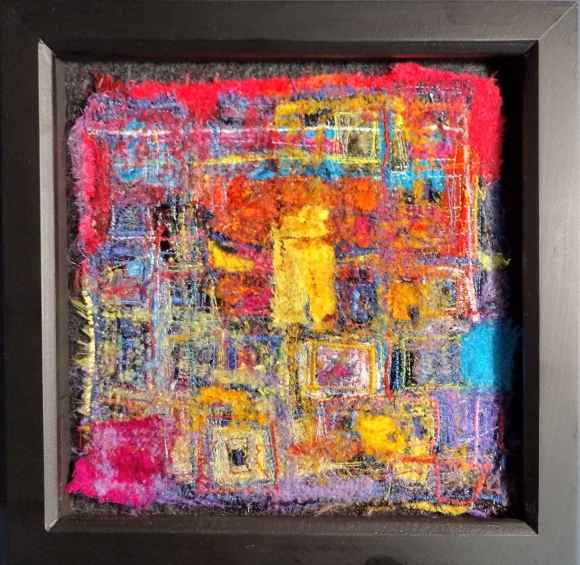
A larger-than-most piece in this series and one I’m happy with, scraps of fabric embellished and stitched, repeatedly. All the work in this series is heavily and repeatedly cut during the making, so as to expose layers of cloth and stitch. The deep box frame came with a rather wide mat/mount so I had a new one made barely 2cm wide. The black box seems to work well with these heavily textured pieces.
East Wind, Mixed textiles, 35 x 35 cm, 2024
As usual the pic doesn’t show the metallic threads or fabrics, or the stitch detail, much higher pixel count is needed for that. I was thinking about the convention in western visual art to read the work from upper left to lower right and how to try and challenge that in a small way. Keeping an idea in mind helps me focus on what I want the work to look like although I might not have a fully formed mental picture of the final result. The whole series could be described as abstract expressionism I think, if one needs labels, made trying to keep the emotion through colour to the fore. The East is Red (somewhat topical again) was in my mind while I was working on it.
Artigo, a lovely art gallery and shop on Gloucester Road, Bristol has a full set of my toy and model kits on sale and has a display of working samples which I’m told by proprietor Diego are popular with children and entertain them while adults are shopping.
Diego has kindly agreed to display for sale some of the textile art pieces I have loosely designated the Meltdown series. These are mostly quite small, colourful and heavily textured, I have named the larger pieces.
Artigo, 20.02.24
I’ve mounted these works in box frame without glass, as with impasto painting the texture is lost under glass. I used different sizes of mat at the front of the box frames (cut by Craftworks, Gloucester Rd, Bristol).
A bit of work-in-progress, embellishing a piece of nuno-felt made long ago onto a slightly quilted white base with strips of variously coloured fabrics sandwiched in between, some stitch next. I suppose I could just as easily call it tornado or cyclone.
Cold Fusion 3 work in progress, embellished nuno-felt, stitching still to come.
I rarely use more than two needles in the embellisher, if all five are used they seem to interact with each other and quickly break, perhaps I am impatient. These needles are currently £2 each or more and they do break easily, practice does help.
Glow in the Dark, work in progress
This piece is also using a piece of old nuno-felt work, overlayed with scraps and lots of stitch, embellished, cut away – repeatedly.
“A newspaper clipping glimpsed in a new documentary is headlined “New Mexico’s Infant Mortality Highest in U.S., Report Says.” Lois Lipman’s film explains why that rate is so high for babies, as well as for others, especially Indigenous and Hispanic inhabitants, in her gripping First We Bombed in New Mexico. Onscreen Tina Cordova, born and raised at Tularosa, only 30 miles from the Trinity Site, declares: “We are the first victims of the atomic bomb.””
The above is from Counterpunch+ behind a paywall, but the film First We Bombed in New Mexico is now released, to rave reviews, I hope it gets to the UK very soon. ’Thousands of New Mexicans – mostly Hispanic and Native American – were exposed to catastrophic levels of radioactive fallout, never warned, never acknowledged and never helped afterwards. Generations of cancers followed.‘
I’ve been working on several pieces in the series I’ve called Meltdown, this is the latest work very much in progress.
Work in progress – Core Melt, about 30cm sq. Embellished, quilted and stitched mixed textiles
I’ve been having a little fun finding names for the pieces instead of just Meltdown 1, 2, 3 &c. and I found, ‘No Risk to the Public’, mildly amusing. The International Atomic Energy ‘Authority’ – the trade body for the nuke industry – likes to claim that far more people have died from the evacuation and it’s subsequent effects at Fukushima than have been irradiated to death, almost as though this is proof that meltdowns are survivable. The fact that a mass evacuation might be necessary at all doesn’t seem to be an issue for them. No one ever needs to be evacuated from a solar or wind farm, biomass converter or a conventional fossil fuel power station. The corium – the many, many tons of melted fuel and containment structure are unlikely to be removed from the site before 2050, if then, because they are too ‘hot’ to handle, even for robots. Of course all that stuff will remain dangerous for thousands of years, there is no safe disposal at this time.
The number of deaths and serious illnesses from radiation released and still being released at Fukushima is disputed and could be many thousands. China, Korea and other states have banned fish from Japan.
The cleanup cost is now estimated at least $200 billion, likely far higher since every estimate so far has proven low – from one incident!





 FlagFly