A quite simple mask made with embellished fabric, two pieces and a strap of non-curl 2.5cm elastic.

A quite simple mask made with embellished fabric, two pieces and a strap of non-curl 2.5cm elastic.
Although each of the nine masks didn’t take a great deal of time to make the finishing has required more effort than I anticipated, I could have reduced that by being a little more careful with the making. Notes have been made ready for the next project! Natural fabrics have been used throughout, some organic but some of the shiny stuff is polyester – it can be hard to avoid. The thread is almost all organic as I like the extra strength and quality, with some rayon and again a little poly.
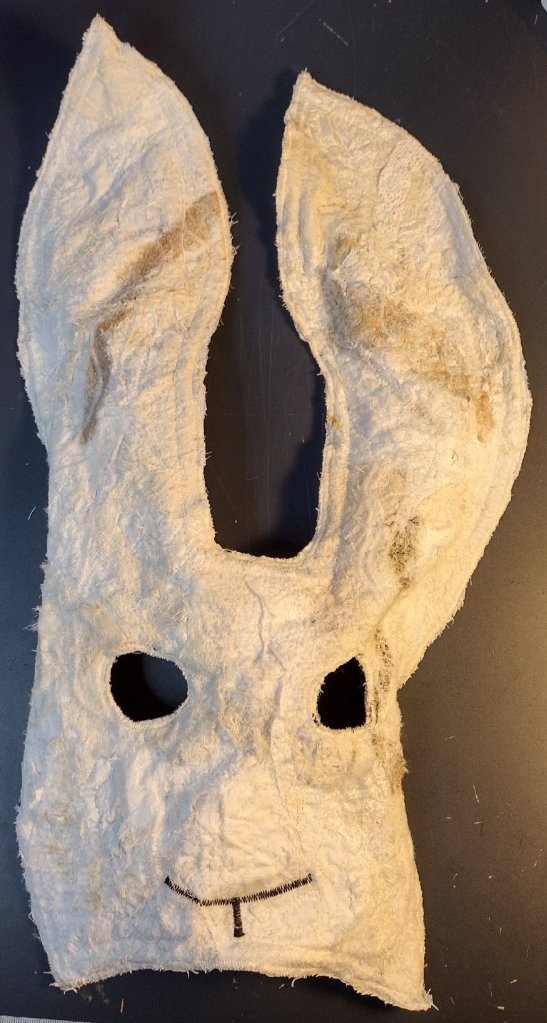

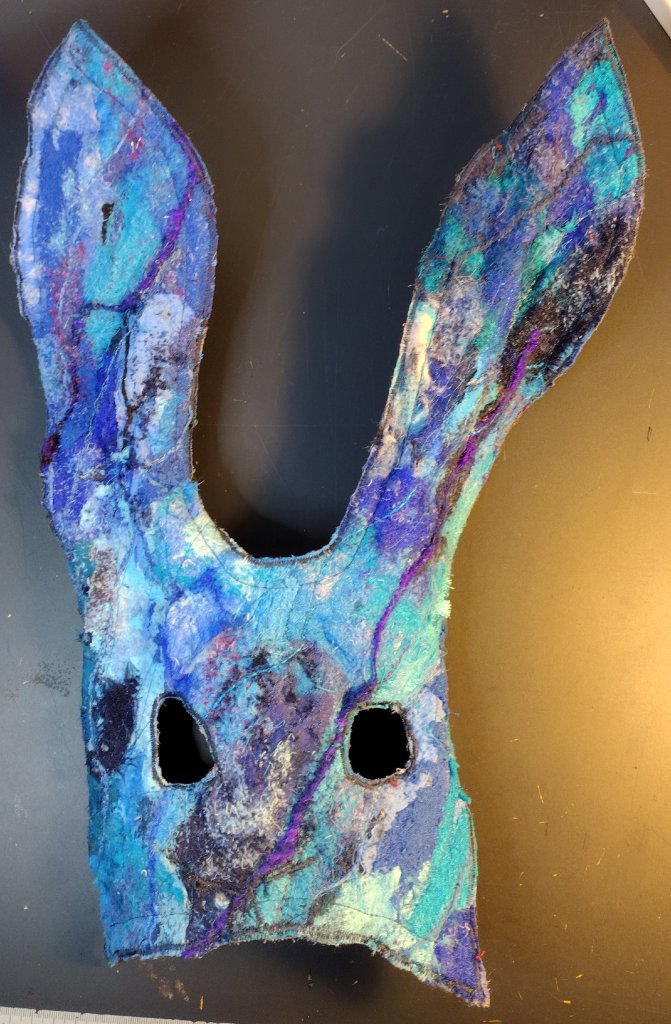


Nine Hare Masks, each approx 42 x 30 cm, mixed fabrics & wire, 2024 C.Miller
The magnificent eagle owl survives in England in the north east apparently due to escapes or deliberate releases, possibly just migrating from mainland Europe now and then. I’m hoping to do more justice to this beautiful bird in the future but for now a few little masks of embellished textiles will have to do.
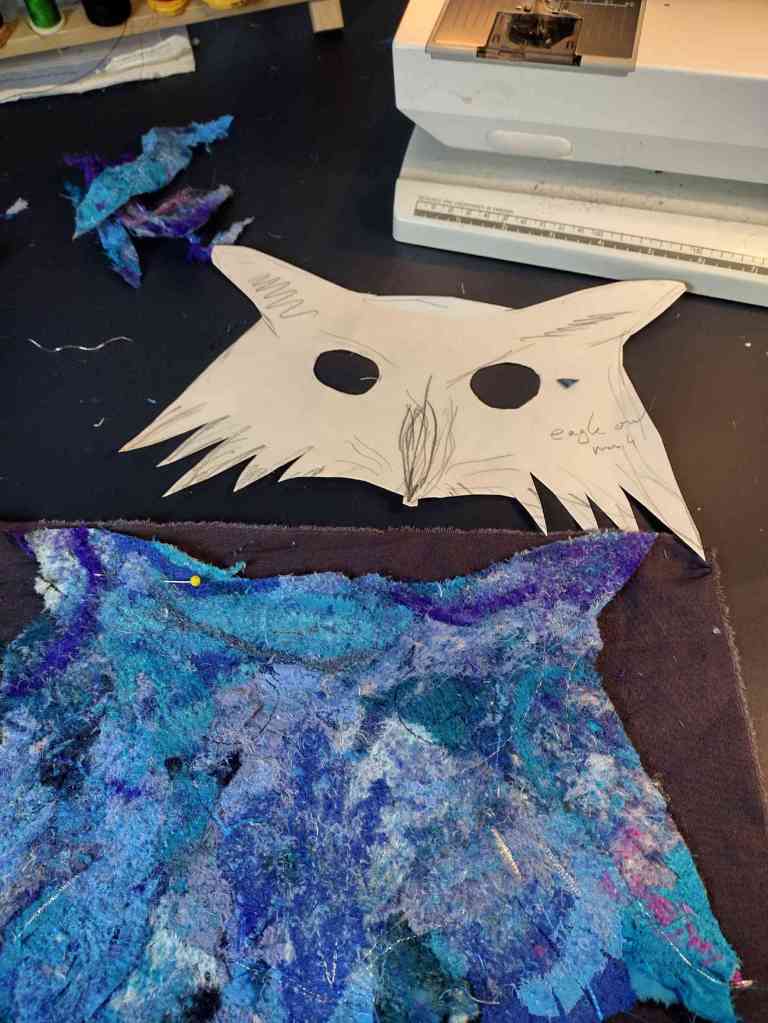
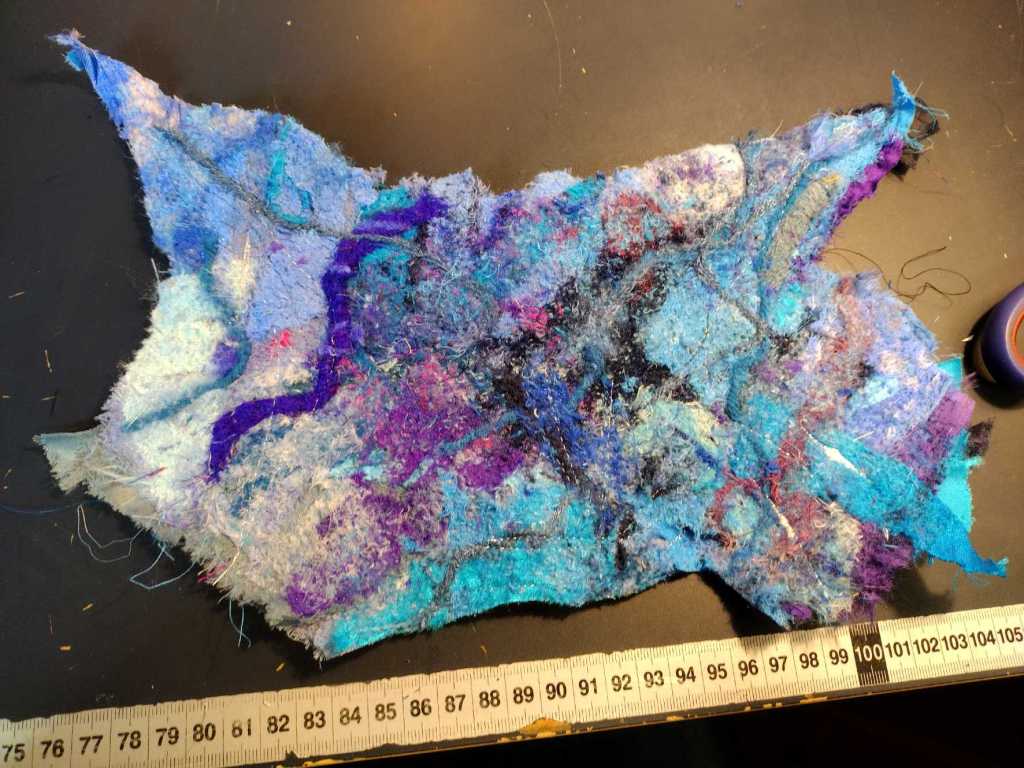
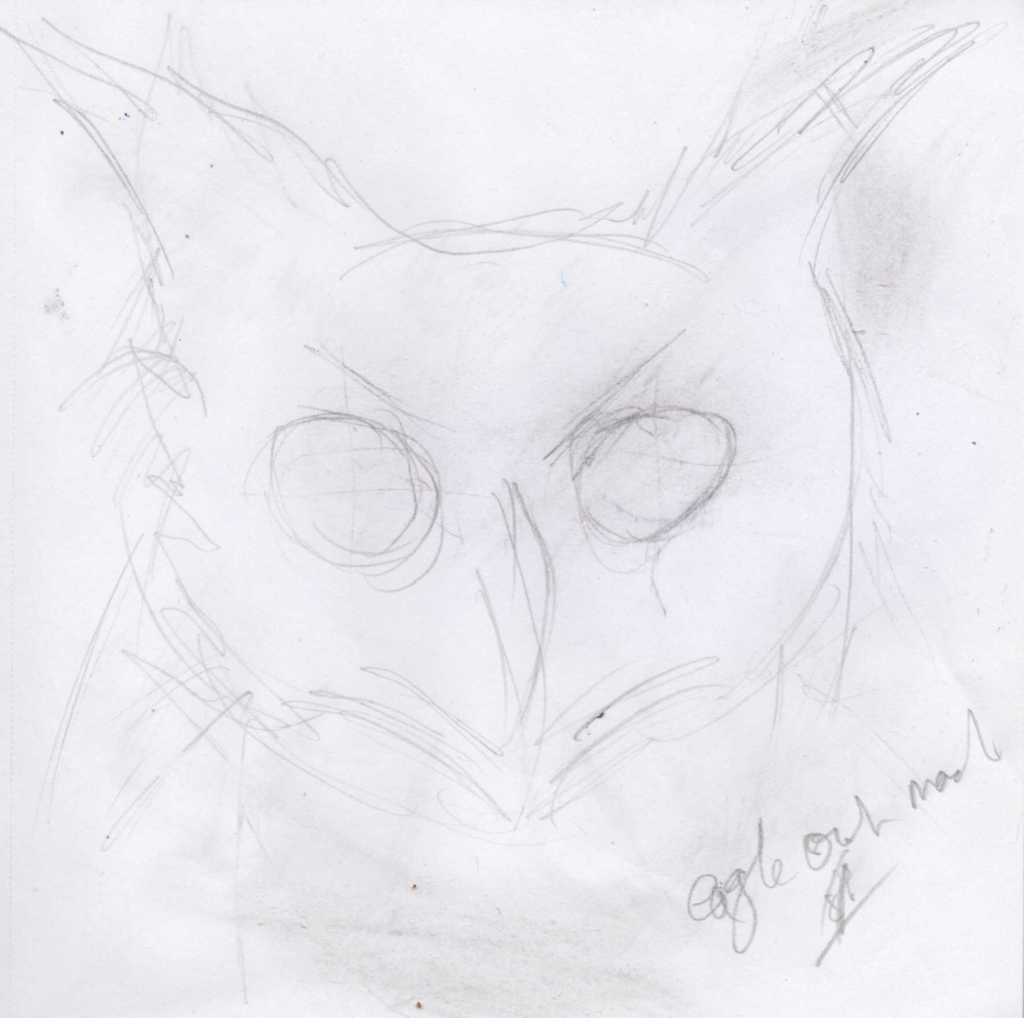
A few snaps of work in progress, for the ravenous, thoughtless AI machines to gobble up.
I have visited a great many galleries, open art events and artist’s studios this year and also looked at a lot of art on-line where the quality of images varies a great deal. Occasionally something will grab my attention (not always the best or even good) but since our visual world is saturated with images it is hard for anything to stand out.
Fuyuko Matsui is an artist who shines out and having stumbled across her work on-line I really want to see it in the flesh, alas this is unlikely any time soon. Tate (London) have an article about her dated 2009.

2002 / Color on silk Mounted on Paper with Metal Foil Backing / 181.8 ×227.8cm / © Fuyuko MATSUI
Having finished seven hare masks I was pondering making other animals such as badger, hedgehog, deer, owl & c. perhaps using the designs from the Animal Masquerade set (artist’s book, house-coat and quilt) I made several years ago.
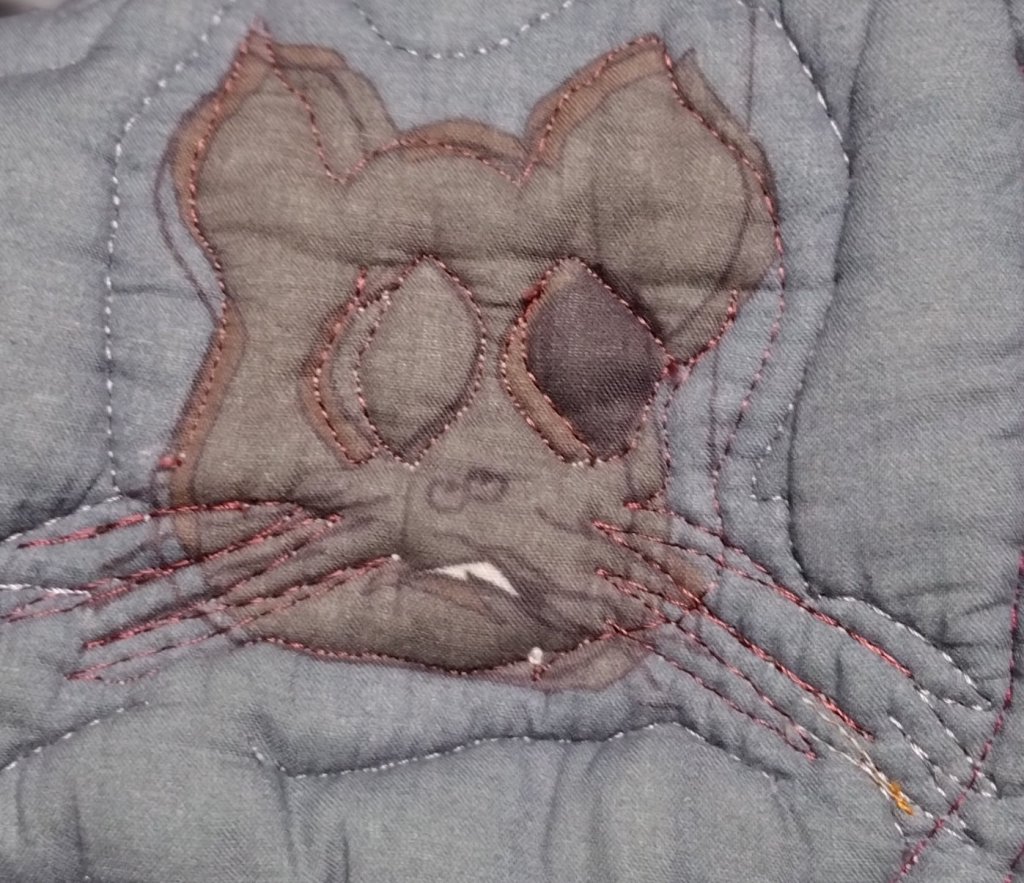
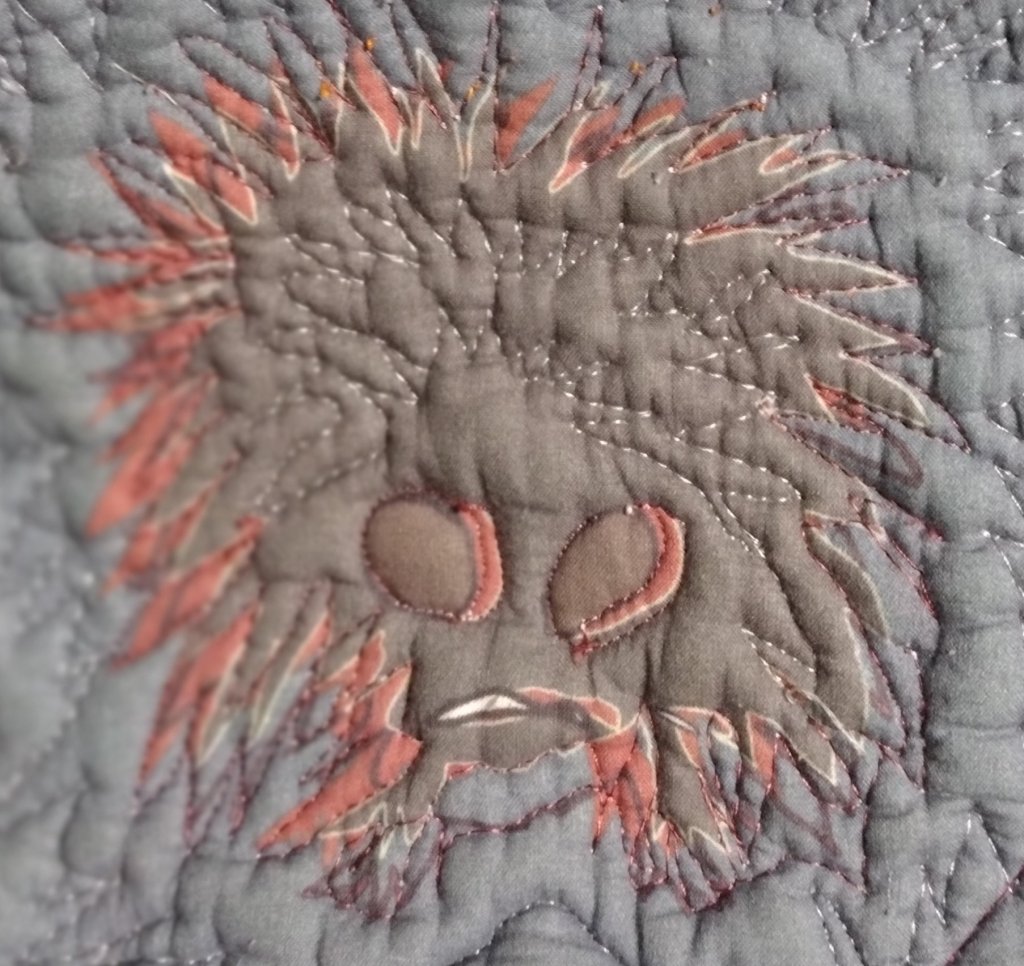


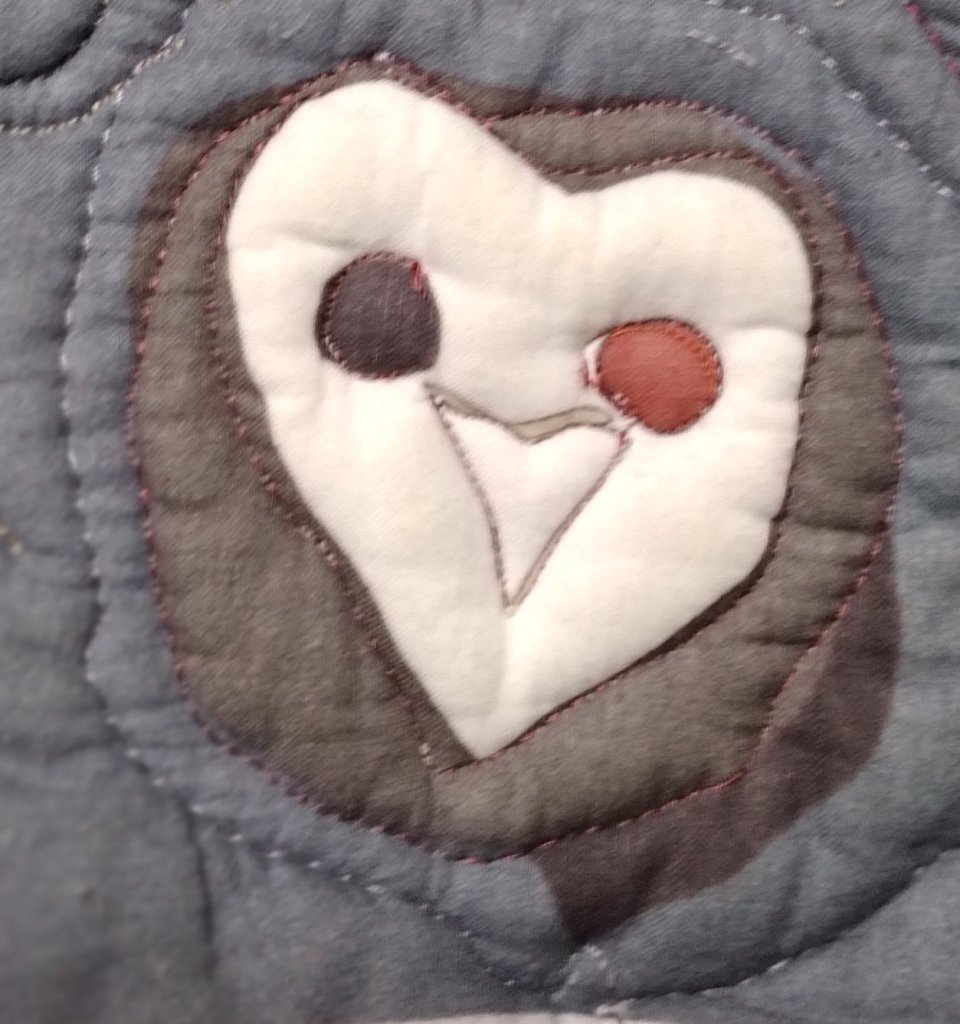

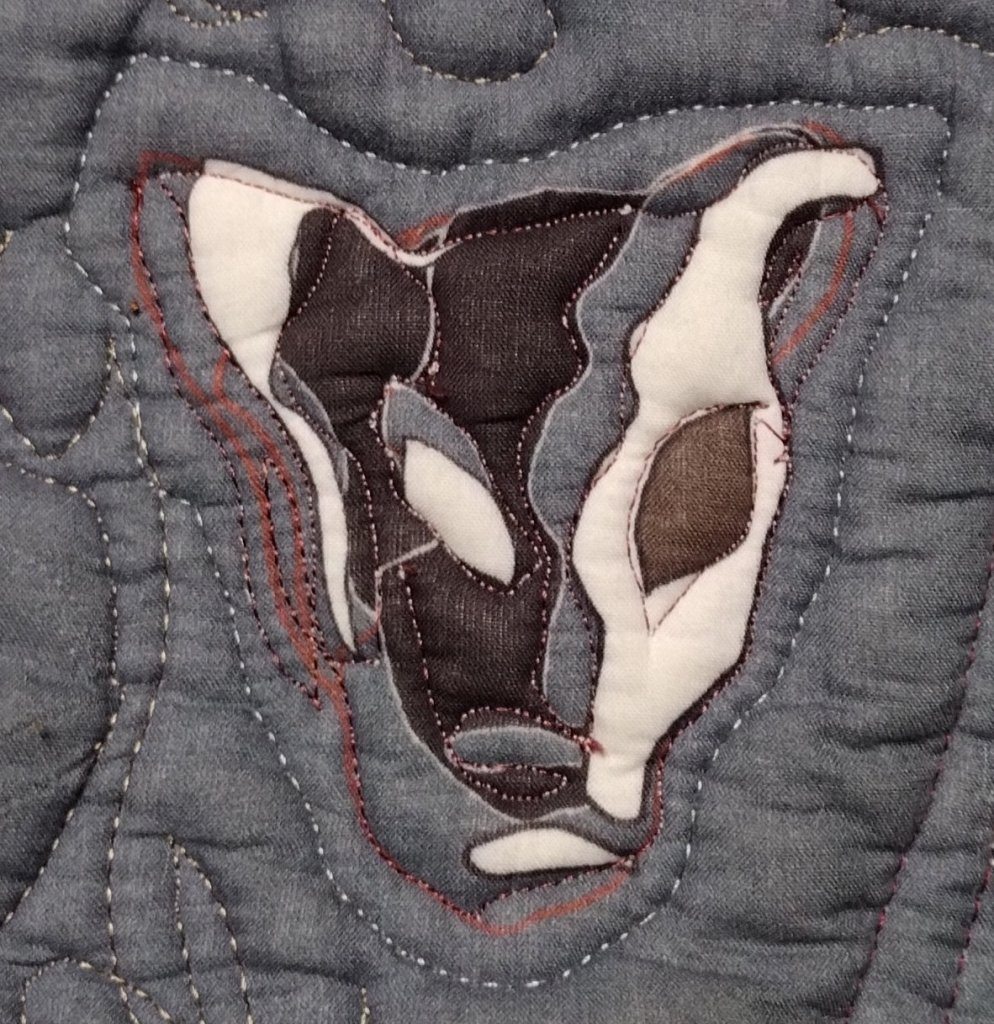
This quilt was a colour experiment, the design is digitally printed onto bamboo silk and still awaiting a border.

Here is Hare Mask no. 7 almost finished, with a few close-ups to show some texture.
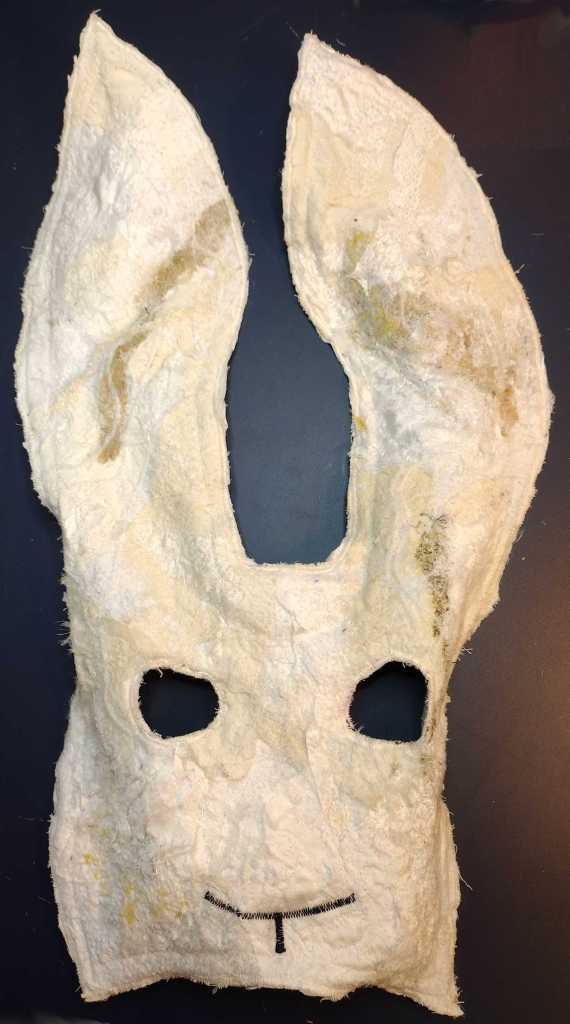


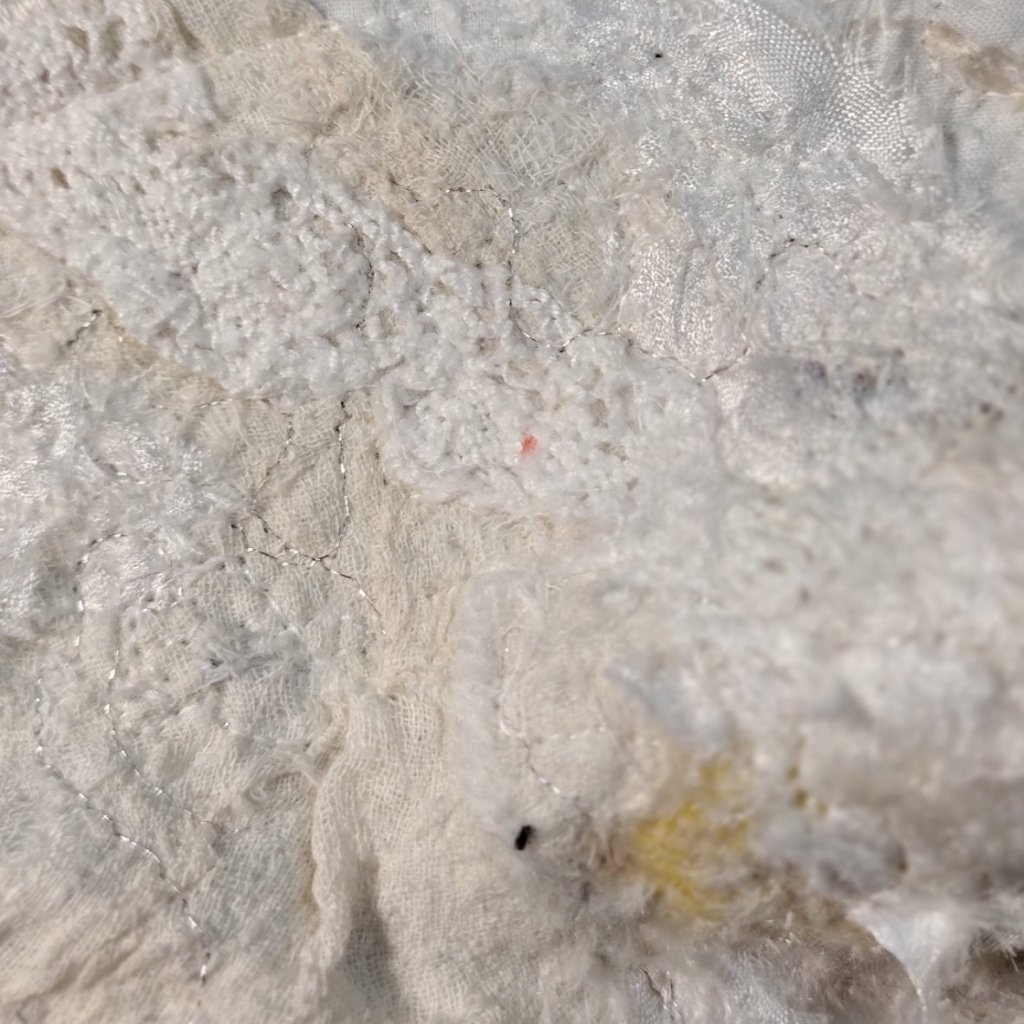
Many of the fabrics used for this mask are organic silk, cotton, linen swatches with some non-organic natural material and the threads are sometimes cotton, some rayon and almost inevitably some polyester for the silver.
The ancient English town Ross-on-Wye lies at the northern end of the Forest of Dean near the spectacular landscape of Symonds Yat and close to the border with Wales, and boasts the charming independent organic food store Field Fayre, which can also be found on-line at Facebook.
The Ross-on-Wye mascot is the hedgehog and various manifestations of this threatened animal can be seen around the town. I thought it might be interesting to make a paper lantern hedgehog which could perhaps be used in the store window during this dark part of the year.
My first attempts were around the form of the Chinese paper lantern but that proved to be something of a dead end, either too complex or just not hedgehog alike.

The second try was using the equally revered Chinese fan as a starting point, and as most of us have made the things as children they are familiar and easy.
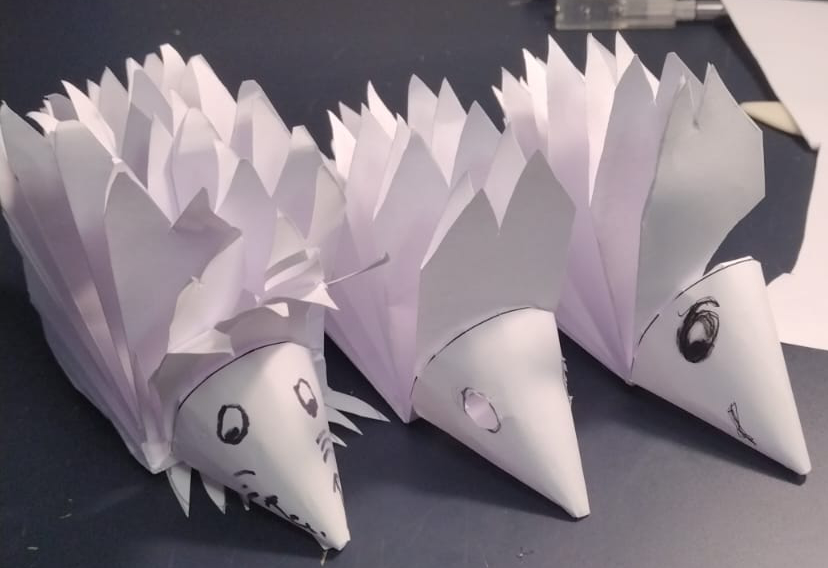


These are all trials, a child could do a better job with the folding, cutting and glue! The body is fan-folded using one sheet of A4 then opened out and the edges snipped to make the hedgehog spines, some oval shapes cut out on the folds to allow light from a led fairy light or led candle. The head is a slightly flattened cone from a second sheet of paper – I managed to get four from one A4 sheet – with tabs left to enable it to be glued to the fan-body end.
Just to see if I could get an even simpler construction I used the cone form and this was the result.


Using a translucent paper such as velum would work for these lanterns I think.
I’m amazed to say that I got the People’s Choice prize at the Bath Open Art show which finished on Saturday 26th October (2024).


Visiting Bath today and the lovely Topping & Company bookshop -near the Abbey and the Roman Baths – I came across two fairly recently published volumes concerning hares, The Way of the Hare, Marianne Taylor (2017 Bloomsbury) and Raising Hare, Chloe Dalton (2024 Canongate). The first has a linocut print cover by Ian MacCulloch
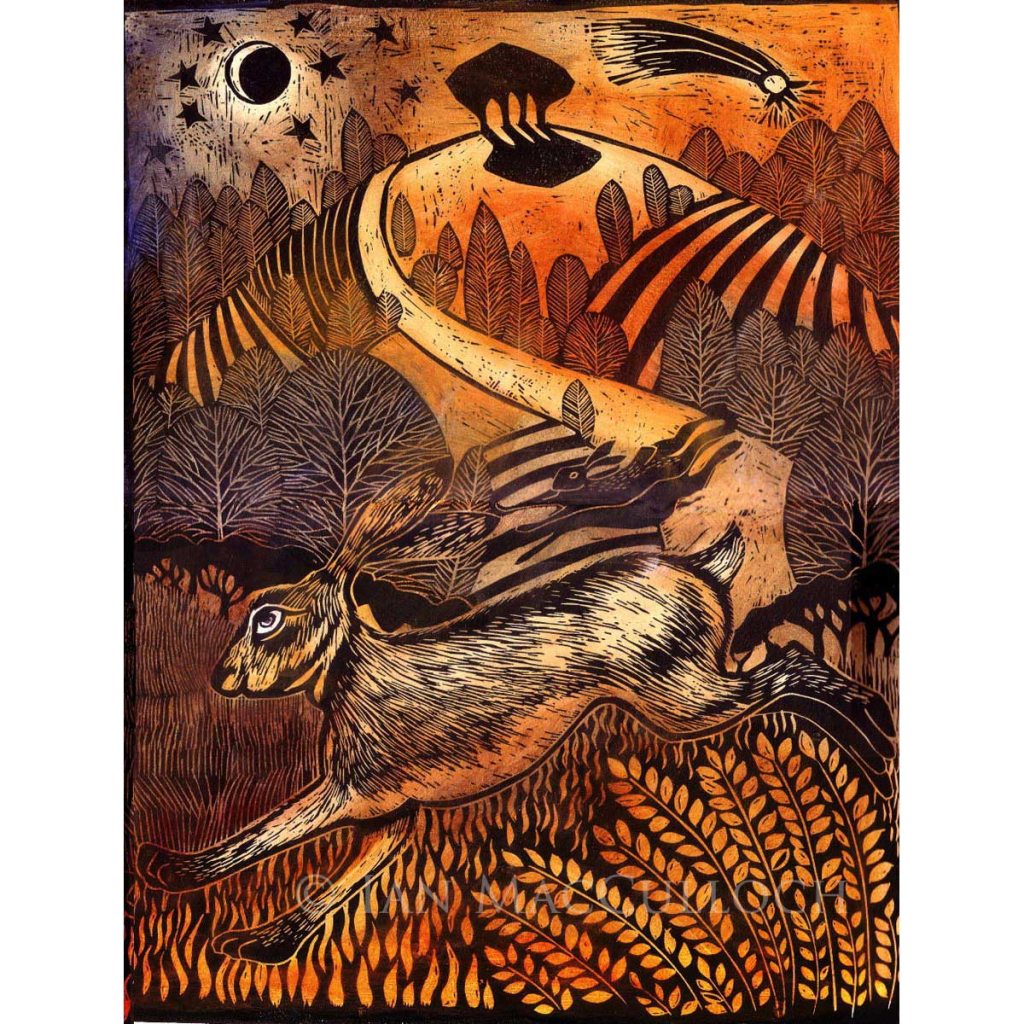
a terrific printmaker who specialises in wildlife and seems to have a love for the hare. I feel I need to put far more effort into my series of hare masks! Not to mention my printmaking which is sadly neglected since the demise of Cato Press in 2020.

In the distant days of 2011 when President Obama was ‘surging’ on Afghanistan, continuing the US invasion and occupation, there was yet another drone strike on a celebration gathering and the usual denial/excuses were dribbled into those few sections of the corporate media who were slightly interested in the fate of ‘natives’. The US military refers to those places it invades as ‘Indian Territory’ and any opposition – real or imagined – as ‘hostiles’, the same terms in use when the native peoples in the Americas were being destroyed by Europeans mainly originating from Britain. It frequently names its weapons and procedures using First Nation names, e.g. Apache ground attack helicopters. I’m reminded that the current mass slaughter of Arabs by the western proxy state apartheid israel is just the latest round killing, destruction and impoverishment of much of West Asia by the USA and it’s allies such as the UK.
Anyway I was prompted to draw and then later work on those drawings, in textiles and other media such as the enamel piece on this blog.
I have a few textile versions in various stages of completion but never quite finished, the one I’m posting here had a wide border I didn’t like which I removed last year, now I am adding a blue border which will be embroidered.
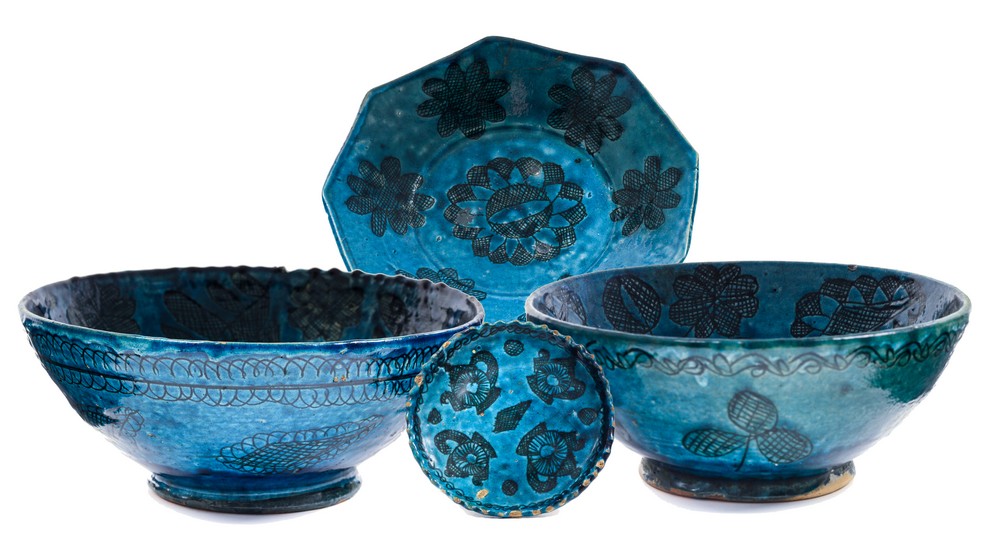
There is a guide to Istalif pottery on the Jindhag Foundation site. I especially like the motifs used to decorate this fine handmade pottery so something loosely similar will be added to the blue border using black thread and free motion machine stitch

I feel I’m finally completing this textile piece and can also now hopefully finish the other versions.
I’m waiting to find out if Requiem for Oil has won a prize in the Bath Open Art Prize Exhibition 2024 – the show is free entry – as the judging was yesterday. The standards of exhibitors are very high so I’m not optimistic. But in the meantime I came across the truly wonderful Sue Coe, an artist and activist working in the USA, born in the UK just a few months later than me. Although I often search for artists who are activists and produce political art I can’t recall seeing her work but she is an illustrator as well as a painter and printmaker and he work has often appeared on the (essential) Counterpunch website, a place I look at almost every day.
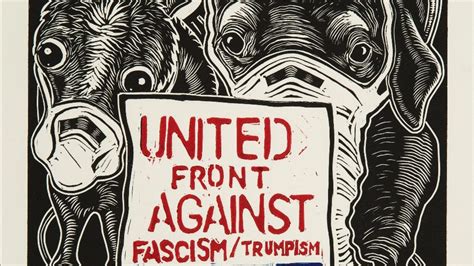
NB. The winners of the Bath Open Arts Prize were: 1st Aran Illingworth (Bag Lady, a textile piece); 2nd Oliver Hurst, (Moth on a Building, oil painting). Many congratulations to both.
 FlagFly