When I was making or remaking embellished work of this type a year or more ago I categorised them all as part of sets called either Meltdown or City, (1,2,3 etc) but later some of them seemed to find other names. This one is now In the Sun. Most of the pics I put on this blog or elsewhere are quite low resolution by current online standards but this one has a few more pixels.
In the Sun, mixed textiles embellished and embroidered, 25×25, box framed, 2024
It can be satisfying to take colour to an extreme.
A larger-than-most piece in this series and one I’m happy with, scraps of fabric embellished and stitched, repeatedly. All the work in this series is heavily and repeatedly cut during the making, so as to expose layers of cloth and stitch. The deep box frame came with a rather wide mat/mount so I had a new one made barely 2cm wide. The black box seems to work well with these heavily textured pieces.
East Wind, Mixed textiles, 35 x 35 cm, 2024
As usual the pic doesn’t show the metallic threads or fabrics, or the stitch detail, much higher pixel count is needed for that. I was thinking about the convention in western visual art to read the work from upper left to lower right and how to try and challenge that in a small way. Keeping an idea in mind helps me focus on what I want the work to look like although I might not have a fully formed mental picture of the final result. The whole series could be described as abstract expressionism I think, if one needs labels, made trying to keep the emotion through colour to the fore. The East is Red (somewhat topical again) was in my mind while I was working on it.
“A newspaper clipping glimpsed in a new documentary is headlined “New Mexico’s Infant Mortality Highest in U.S., Report Says.” Lois Lipman’s film explains why that rate is so high for babies, as well as for others, especially Indigenous and Hispanic inhabitants, in her gripping First We Bombed in New Mexico. Onscreen Tina Cordova, born and raised at Tularosa, only 30 miles from the Trinity Site, declares: “We are the first victims of the atomic bomb.””
The above is from Counterpunch+ behind a paywall, but the film First We Bombed in New Mexico is now released, to rave reviews, I hope it gets to the UK very soon. ’Thousands of New Mexicans – mostly Hispanic and Native American – were exposed to catastrophic levels of radioactive fallout, never warned, never acknowledged and never helped afterwards. Generations of cancers followed.‘
I’ve been working on several pieces in the series I’ve called Meltdown, this is the latest work very much in progress.
Work in progress – Core Melt, about 30cm sq. Embellished, quilted and stitched mixed textiles
I’ve been having a little fun finding names for the pieces instead of just Meltdown 1, 2, 3 &c. and I found, ‘No Risk to the Public’, mildly amusing. The International Atomic Energy ‘Authority’ – the trade body for the nuke industry – likes to claim that far more people have died from the evacuation and it’s subsequent effects at Fukushima than have been irradiated to death, almost as though this is proof that meltdowns are survivable. The fact that a mass evacuation might be necessary at all doesn’t seem to be an issue for them. No one ever needs to be evacuated from a solar or wind farm, biomass converter or a conventional fossil fuel power station. The corium – the many, many tons of melted fuel and containment structure are unlikely to be removed from the site before 2050, if then, because they are too ‘hot’ to handle, even for robots. Of course all that stuff will remain dangerous for thousands of years, there is no safe disposal at this time.
The number of deaths and serious illnesses from radiation released and still being released at Fukushima is disputed and could be many thousands. China, Korea and other states have banned fish from Japan.
The cleanup cost is now estimated at least $200 billion, likely far higher since every estimate so far has proven low – from one incident!
One day I might get around to trying to sell some of these pieces, but in the meanwhile I’m enjoying working on them. Netflix have recently released an intriguing documentary about the 1979 Three Mile Island ‘partial’ (wikipedia) meltdown in Pennsylvania, a then brand-new plant that the makers knew had ‘issues’. Needless to say no executives of the companies concerned suffered in any legal way.
The use of the word ‘partial’ by Wikipedia referring to this incident is telling, a ‘complete’ meltdown would supposedly lead to the remains of the fuel – after various explosions, widespread contamination etc. – burning down through the earth towards China (China Syndrome) although in reality when the corium (the mix of fuel and support structure) hit the water table the entire mess would likely explode repeatedly and spread devastation across a huge area. The documentary makes clear that the incident was 30 minutes away from a catastrophe similar or likely far worse than Fukushima.
Wikipedia also repeats the word ‘accident’, where ‘incident’ is appropriate thus helping to disguise the fact of the cover-up of known problems before the plant opened.
Unlike the Fukushima meltdowns there wasn’t much to see at Three Miler Island mainly because likely hydrogen explosions didn’t happen, more by luck than anything else.
The hundreds of nukes operating around the world have no long-term storage for their ultra-long-term poisonous, highly radioactive waste, many of them are ancient, metal fatigued, rusting and dangerous. Some, like Diablo Canyon, California are all this and sit on earthquake fault lines. All are capable of bringing cataclysmic destruction to their regions and far beyond.
In December 2023 the California Public Utilities Commission approved a proposal to keep Diablo Canyon’s twin reactors online, overturning an earlier agreement to close the plant in 2025. I have not heard anyone say that this plant could withstand a tsunami, although a large earthquake in the region is considered to be overdue. California had 7,339 earthquakes in the past year, I don’t know how that compares to other places.
I wish I had the artistic skill to reflect the mayhem and hubris of nuclear power and all it represents.
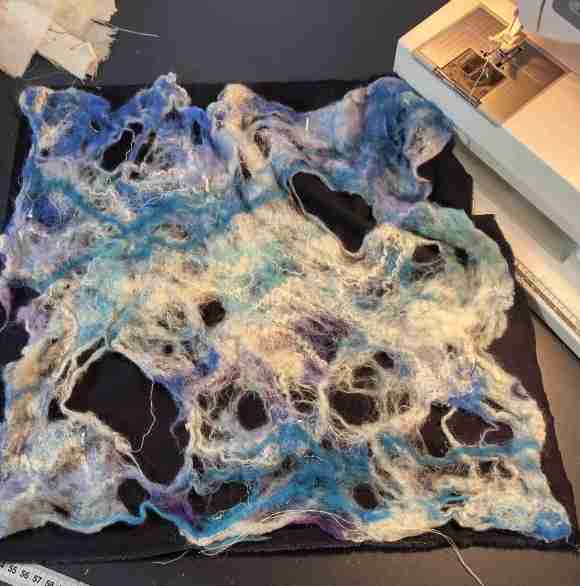
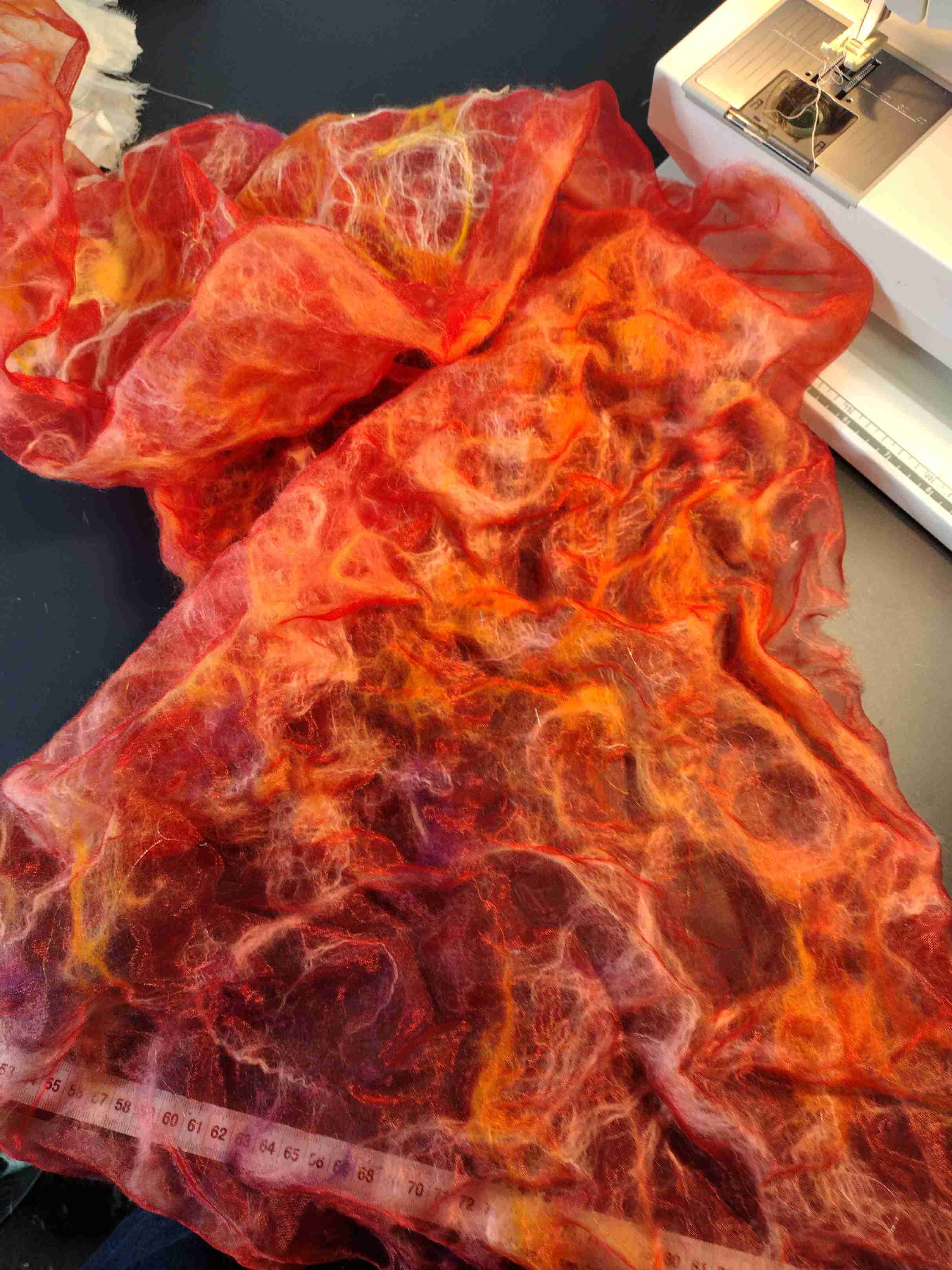
Sorting through piles of old fabric scraps I came across these pieces of nunofelt, made many years ago on my kitchen table. These are left over from some other half-forgotten project, party clothing for a friend. Now to be reworked as Meltdown Cold Fusion (lol), the blue piece …
Nunofelt on black cotton, 45 cm sq, work in progress
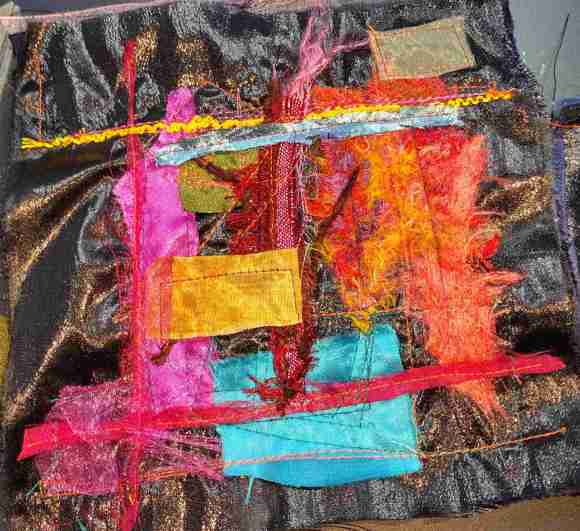
After a busy few days in London, several art galleries as well as street actions culminating in the gigantic – 800,000 peaceful folk – Palestine demo I’m doing some sewing, revising some old ideas. Meltdown, a series of fabric pieces, embellished, embroidered and heavily stitched, begun in 2015 as a response to the disaster at Fukushima (2011 on-going).
Meltdown pieces at the sewing machine, about 20 x 20 cm
The subtlety of colour and stitch is rather lost in these photos.
I enjoy creating something – maybe not beautiful but hopefully of interest – using the tiniest of scraps picked up from the studio floor or stuffed away in waste bags.
Most of the thread I use for larger pieces or clothes (rare now) is organic cotton which is a little heavier than ordinary cotton, but for this work rayon, made from wood pulp is perfectly good. Not a plug just that these are widely available, Marathon rayon threads are very low cost and although they can be a little weak for some work they have a pleasant lustre and strength isn’t an issue here.
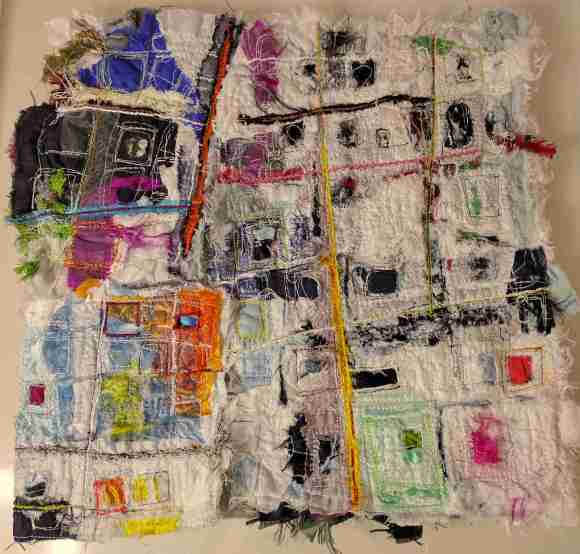
I am having a clear up and out, and I came across these small pieces from a few years back when I was pursuing an MA in Multidisciplinary Printmaking at Bower Ashton in Bristol. I made them with the Fukushima fiasco in mind, knowing that would be a topical issue all my remaining life and beyond. Fukushima is in the news again as the authorities want to release a million tons of radioactive water into the sea, Uproar Over Japan’s Decision to Disperse Radioactive Fukushima Waste Water and the situation at the site remains dire. I made about ten, gave some away.
I’m thinking of re-framing them perhaps as a single piece, but undecided about the type of frame, a black painted board? These scanned images are fuzzy, the originals have a lot more detail.
Meltdown, 1,2,3,4, approx A4, mixed textiles and embroidery





 FlagFly