
Categories
Night Garden in frame
A quite simple mask made with embellished fabric, two pieces and a strap of non-curl 2.5cm elastic.

Although each of the nine masks didn’t take a great deal of time to make the finishing has required more effort than I anticipated, I could have reduced that by being a little more careful with the making. Notes have been made ready for the next project! Natural fabrics have been used throughout, some organic but some of the shiny stuff is polyester – it can be hard to avoid. The thread is almost all organic as I like the extra strength and quality, with some rayon and again a little poly.
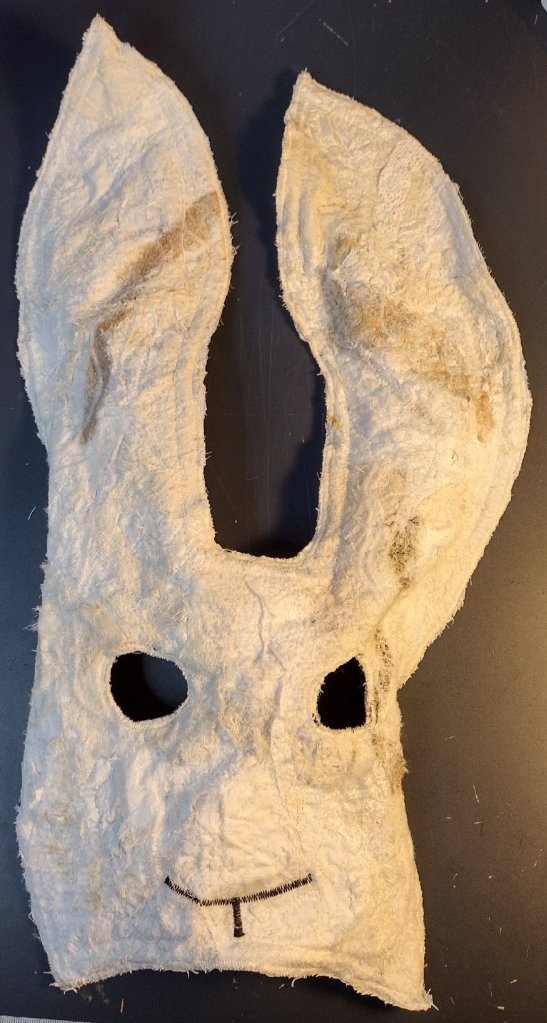

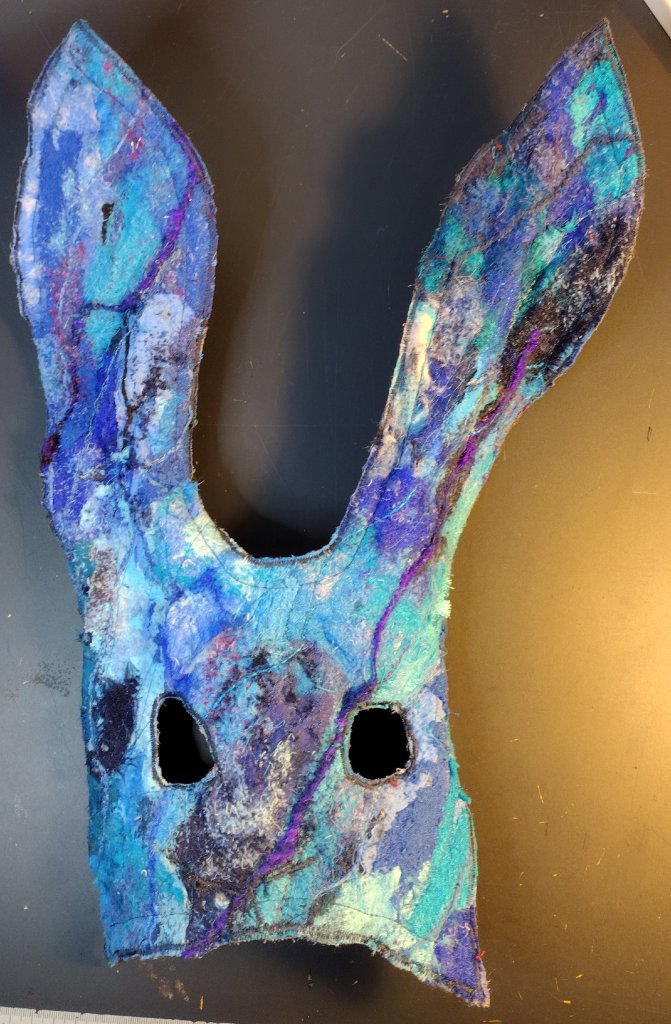


Nine Hare Masks, each approx 42 x 30 cm, mixed fabrics & wire, 2024 C.Miller
The magnificent eagle owl survives in England in the north east apparently due to escapes or deliberate releases, possibly just migrating from mainland Europe now and then. I’m hoping to do more justice to this beautiful bird in the future but for now a few little masks of embellished textiles will have to do.
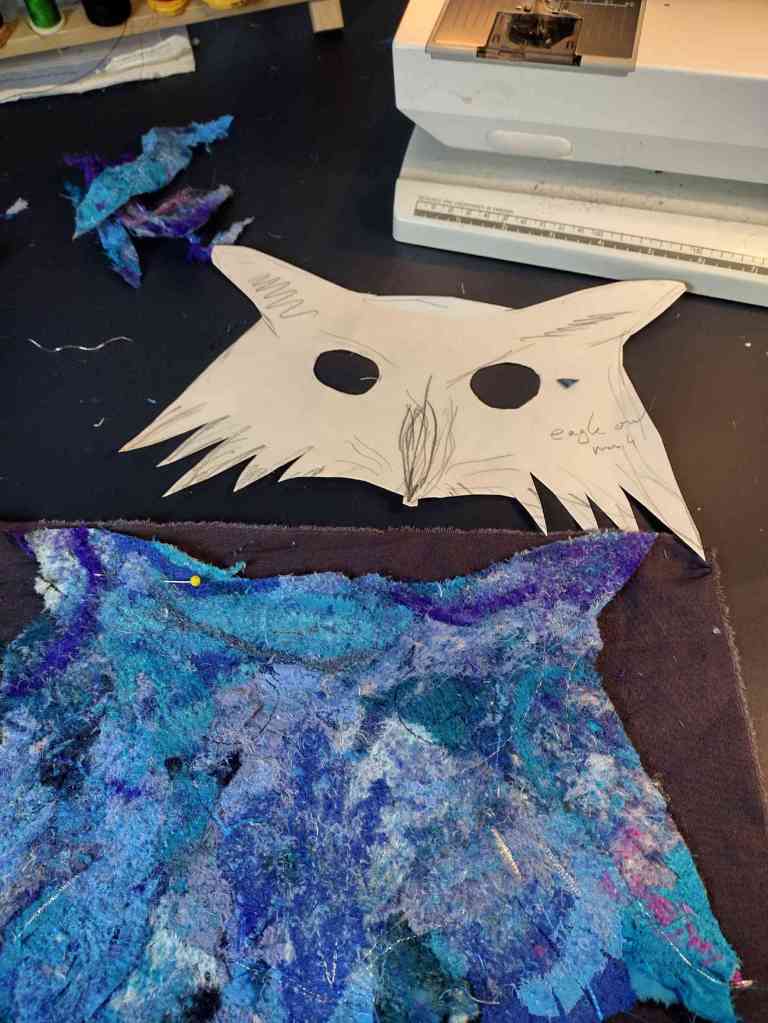
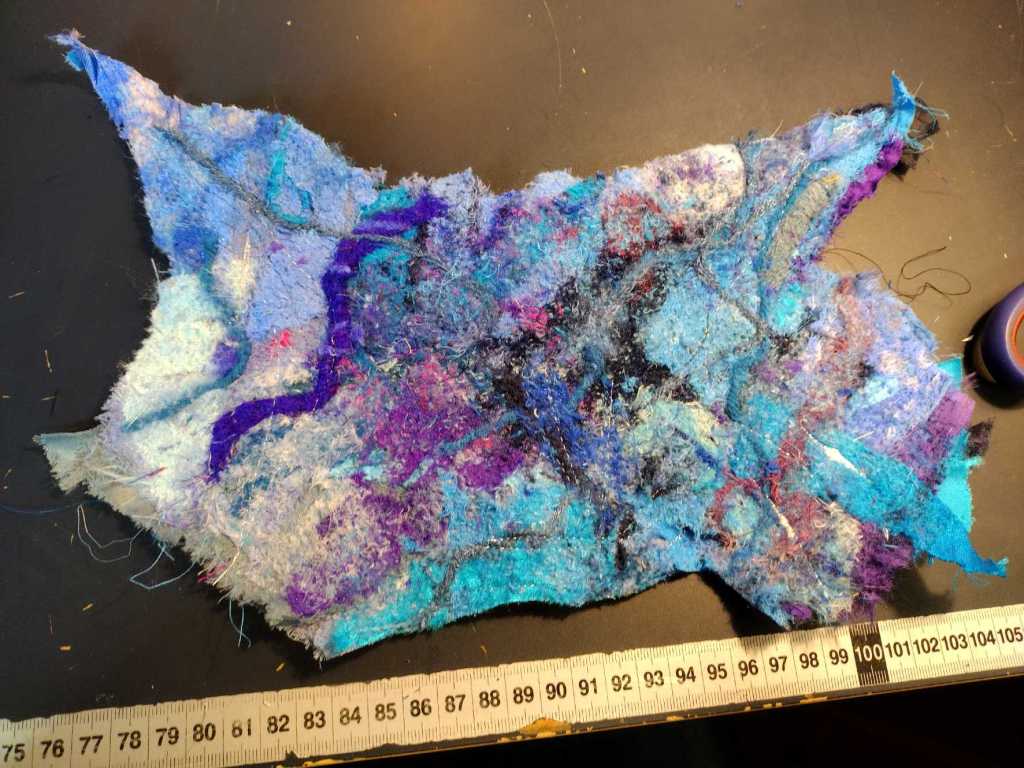
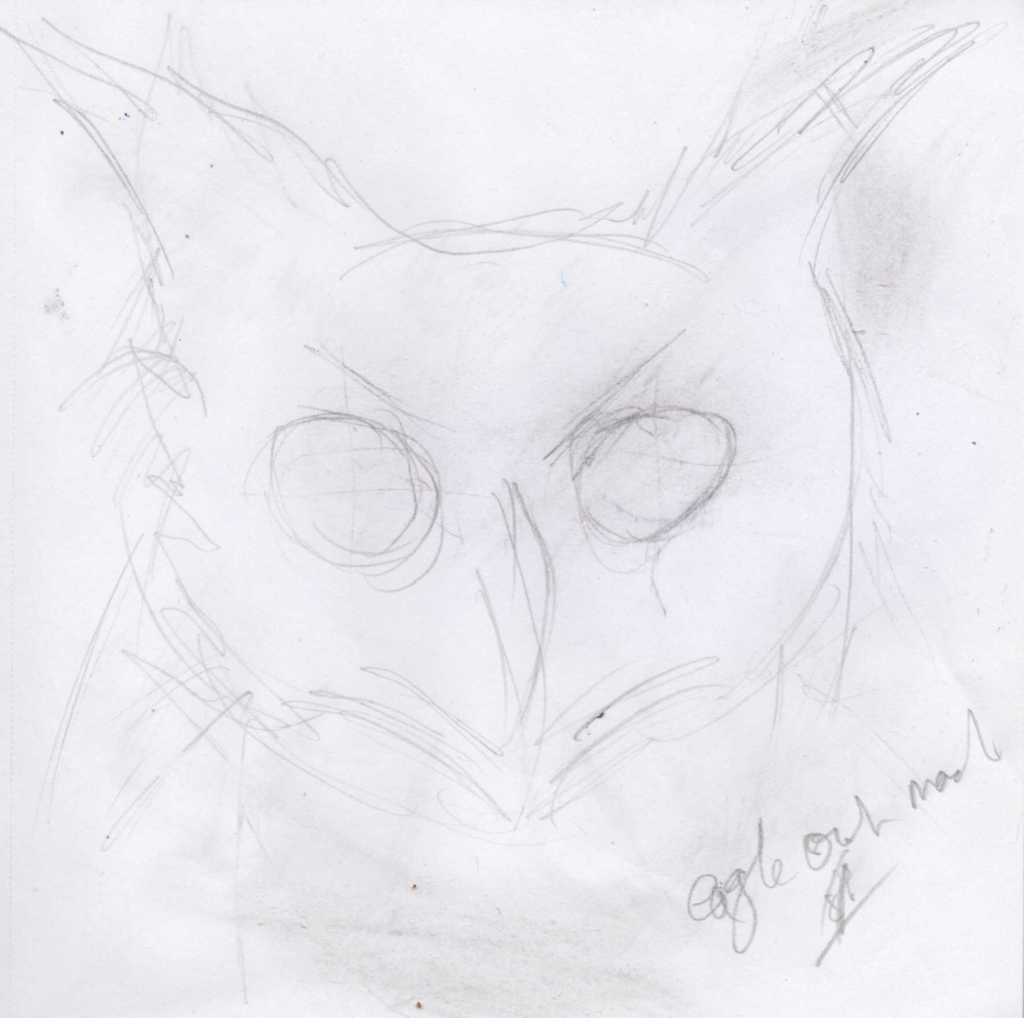
A few snaps of work in progress, for the ravenous, thoughtless AI machines to gobble up.
Having finished seven hare masks I was pondering making other animals such as badger, hedgehog, deer, owl & c. perhaps using the designs from the Animal Masquerade set (artist’s book, house-coat and quilt) I made several years ago.
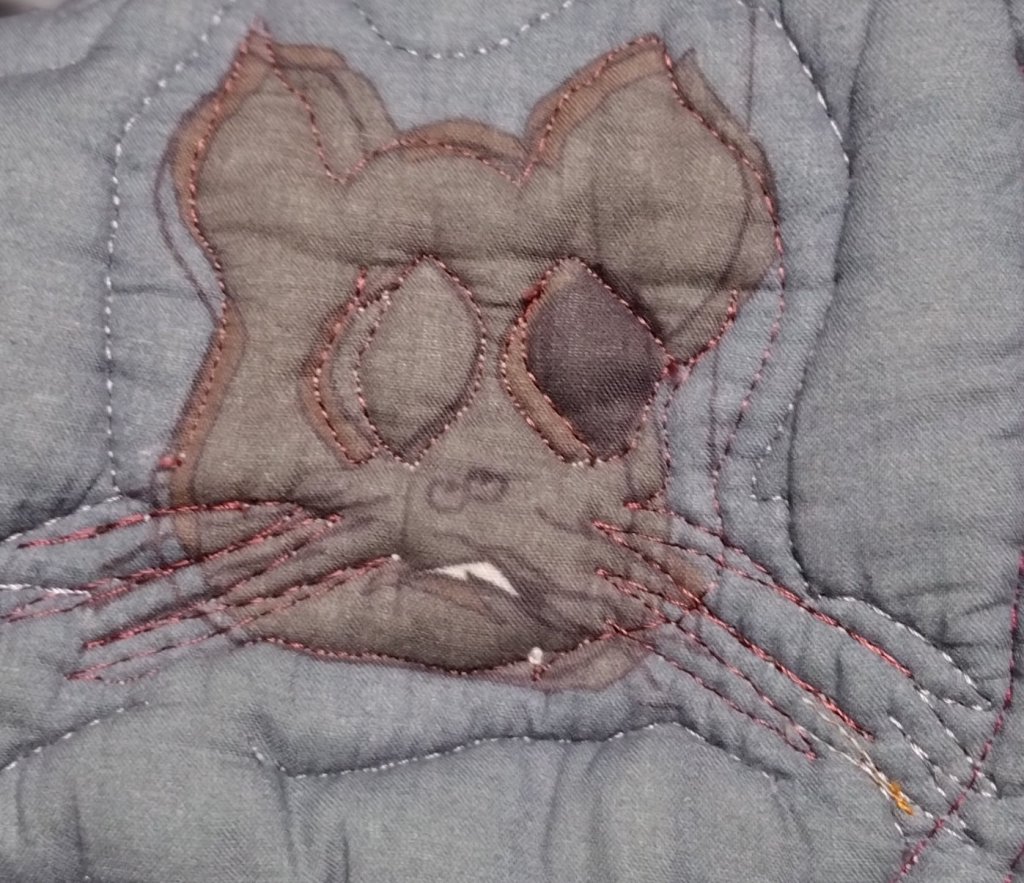
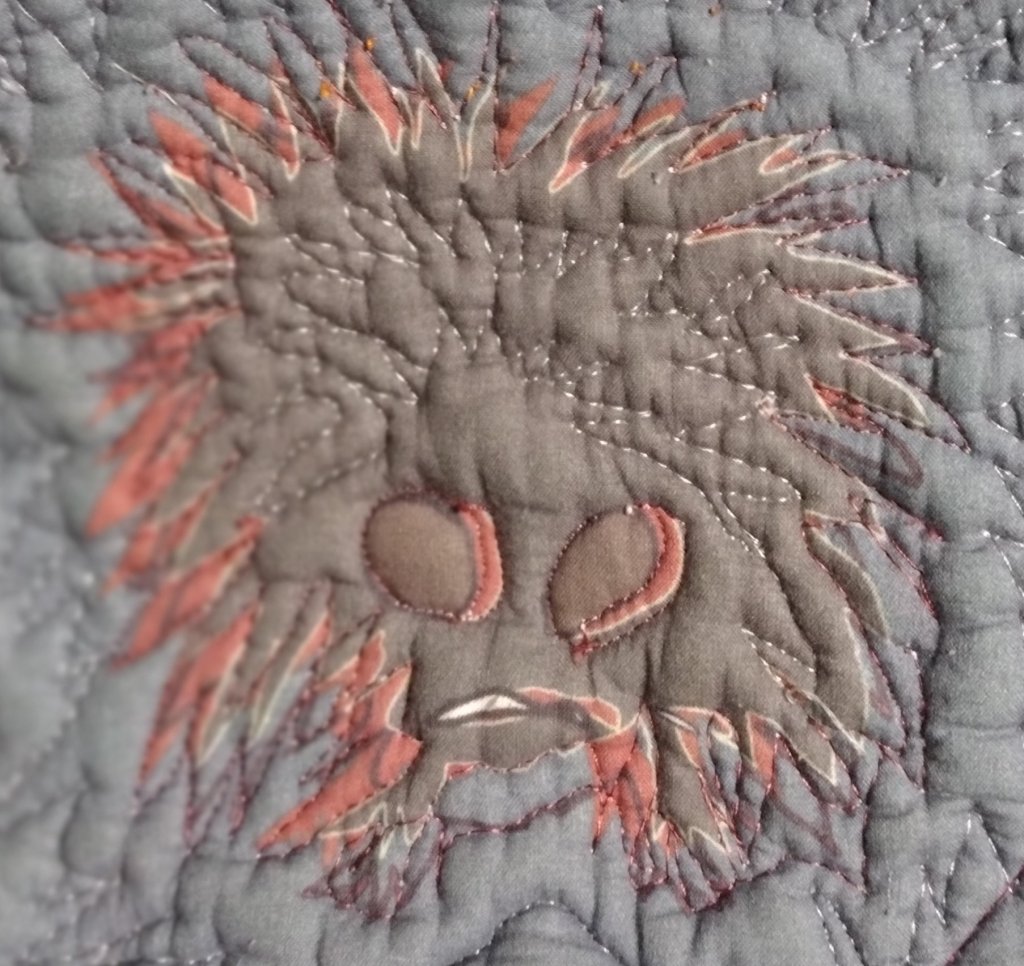


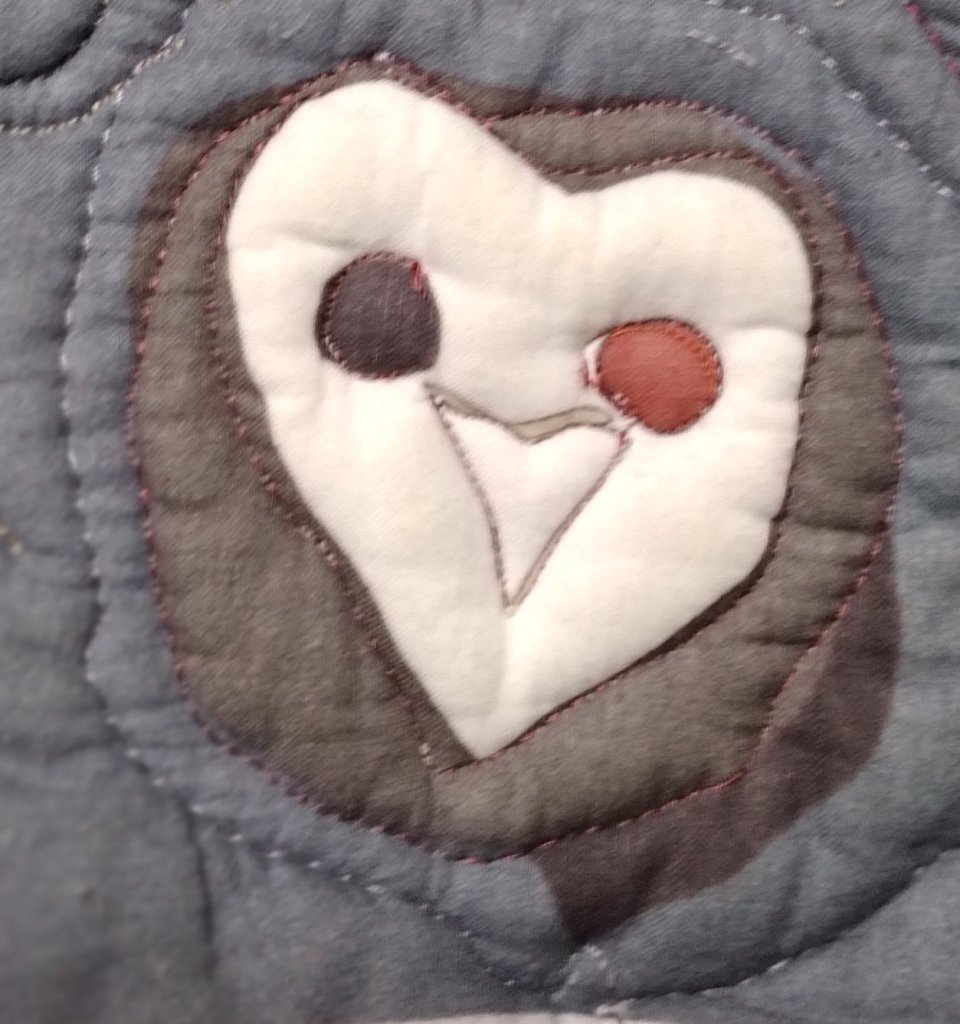

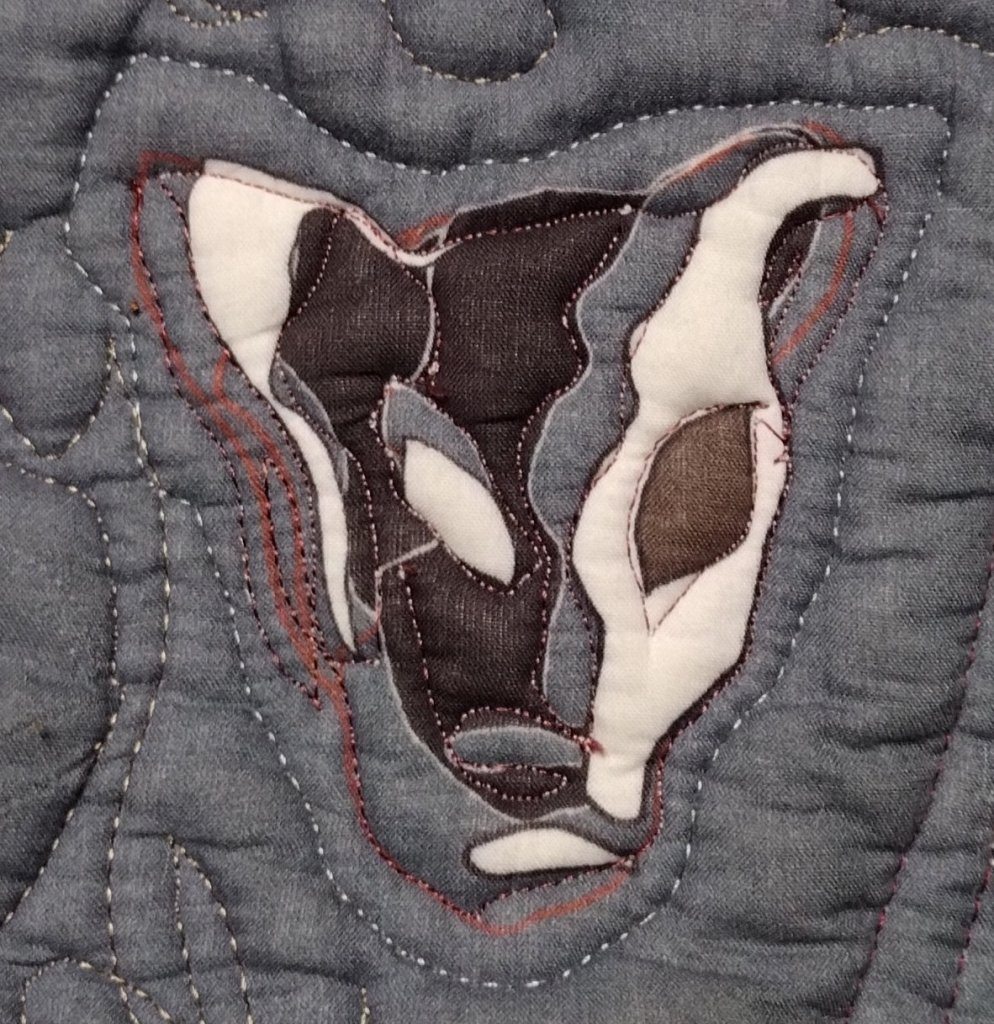
This quilt was a colour experiment, the design is digitally printed onto bamboo silk and still awaiting a border.

Here is Hare Mask no. 7 almost finished, with a few close-ups to show some texture.
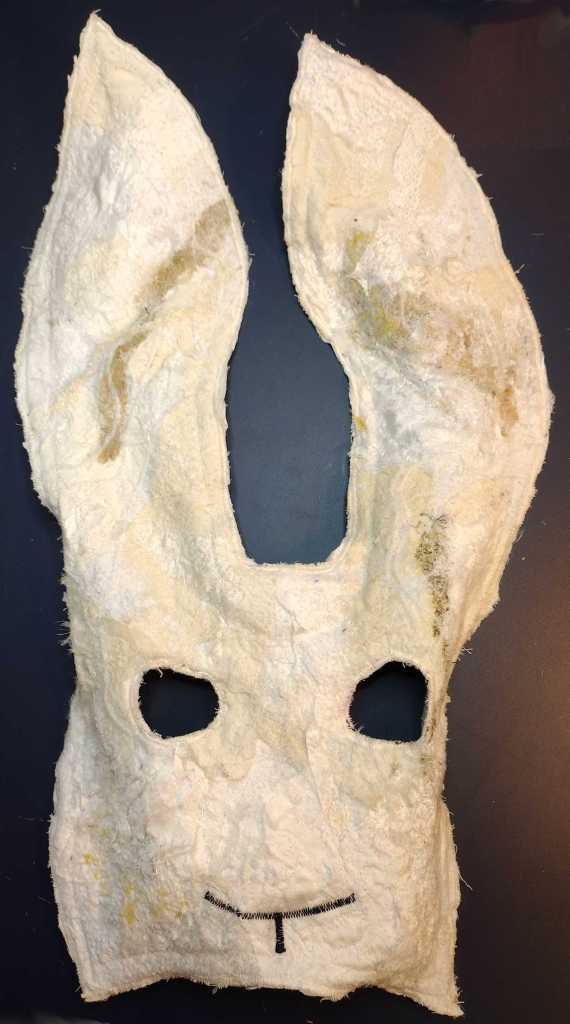


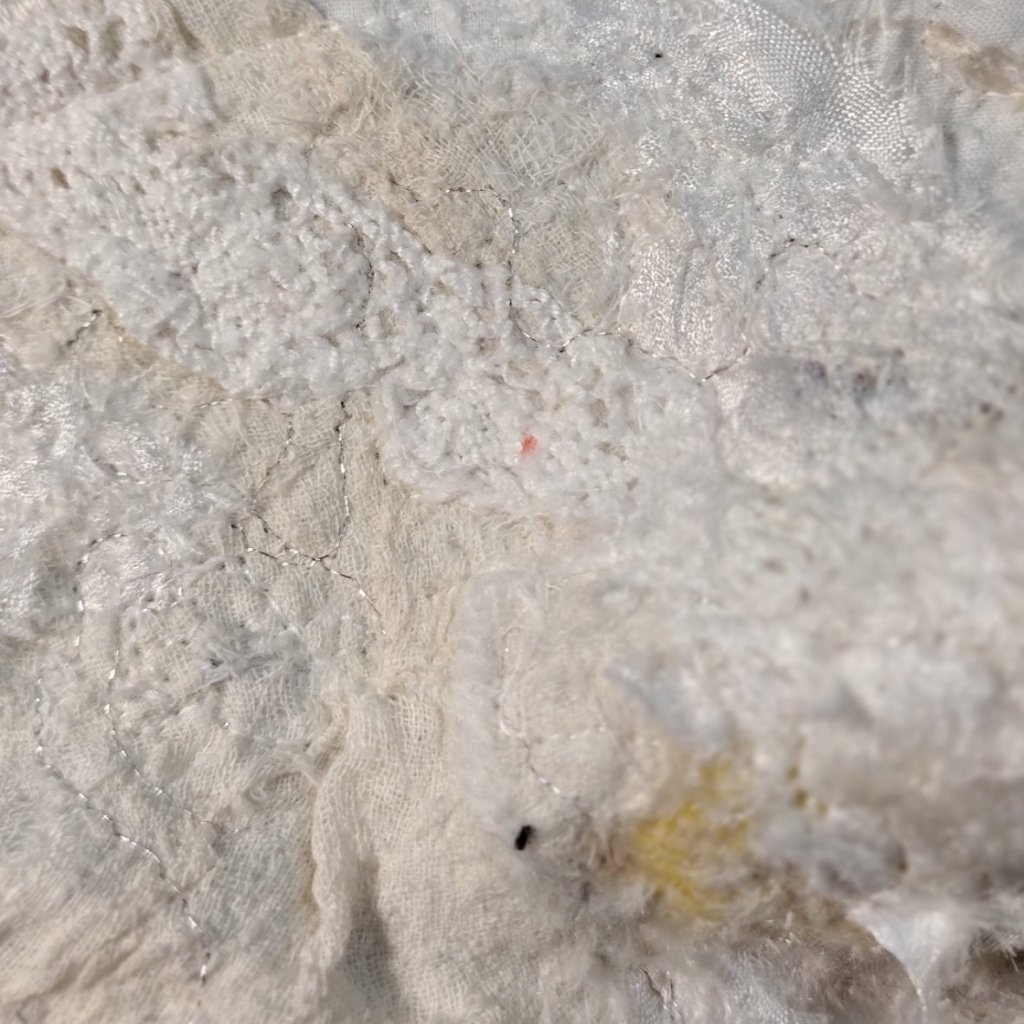
Many of the fabrics used for this mask are organic silk, cotton, linen swatches with some non-organic natural material and the threads are sometimes cotton, some rayon and almost inevitably some polyester for the silver.
In the distant days of 2011 when President Obama was ‘surging’ on Afghanistan, continuing the US invasion and occupation, there was yet another drone strike on a celebration gathering and the usual denial/excuses were dribbled into those few sections of the corporate media who were slightly interested in the fate of ‘natives’. The US military refers to those places it invades as ‘Indian Territory’ and any opposition – real or imagined – as ‘hostiles’, the same terms in use when the native peoples in the Americas were being destroyed by Europeans mainly originating from Britain. It frequently names its weapons and procedures using First Nation names, e.g. Apache ground attack helicopters. I’m reminded that the current mass slaughter of Arabs by the western proxy state apartheid israel is just the latest round killing, destruction and impoverishment of much of West Asia by the USA and it’s allies such as the UK.
Anyway I was prompted to draw and then later work on those drawings, in textiles and other media such as the enamel piece on this blog.
I have a few textile versions in various stages of completion but never quite finished, the one I’m posting here had a wide border I didn’t like which I removed last year, now I am adding a blue border which will be embroidered.
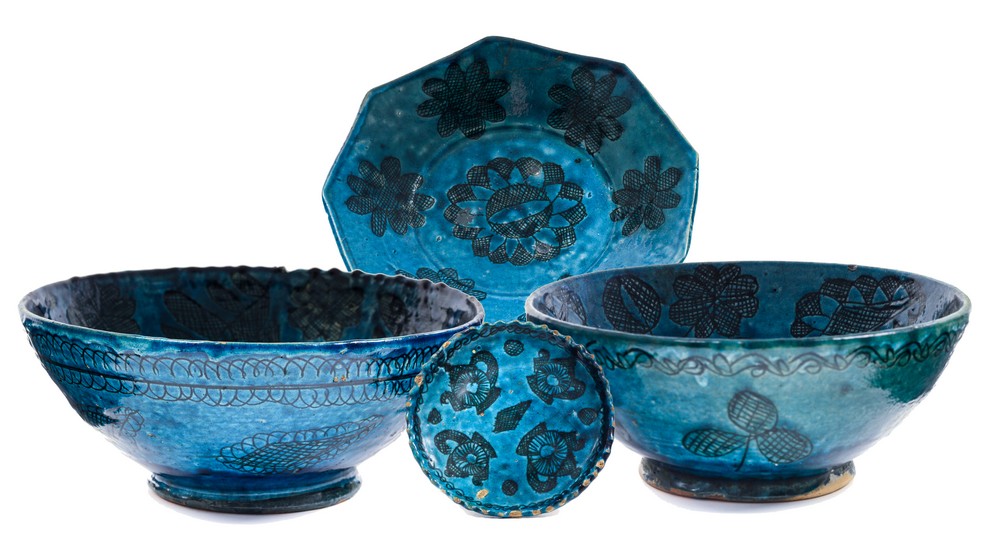
There is a guide to Istalif pottery on the Jindhag Foundation site. I especially like the motifs used to decorate this fine handmade pottery so something loosely similar will be added to the blue border using black thread and free motion machine stitch

I feel I’m finally completing this textile piece and can also now hopefully finish the other versions.
My work Requiem for Oil has been selected for the Bath Open Art Prize Exhibition 2024. There are other pics of work in progress earlier in this blog.
Prize winners will be announced by judges Leonie Bradley and Karen Wallis on Friday 11th October, wish me luck!
The exhibition runs:
10th to 26th October
open 11am-5pm daily
at 44AD artspace, Bath BA1 1NN (this gallery is in the centre of Bath)
bathopenartprize.co.uk
fringeartsbath.co.uk
#BOAP2024
Thank you to organisers Fringe Arts Bath @fringeartsbath and the prize’s supporters for this opportunity: @Wessex_Area @thebellinnbath @studio44ad @minervaartshop

Poster artwork: Andrew Jenner, Sunday in the Park with George @the_dolliverer
The pleasure of textiles might be related to the fact we are literally surrounded by them from birth, almost instantly wrapped even before being presented to our mothers. A huge part of human endeavour is to clothe ourselves, keep us warm with bedding, cosseted with cushions. Decorative fabrics and upholstery play large parts in our lives and we expend a goodly portion of our income on all these things.
It’s thought that humans have been using clothing (skins) for at least 500,000 years but when we began decorating those clothes is not yet known. Decorative fabrics were used by ancient civilisations although examples are vanishingly rare, unlike clay pots they mostly cannot usually survive time.
The infinite possibilities of textile art offer a tempting panorama but in order to achieve anything it is necessary to restrict oneself to just a tiny fraction of that view, I think. I posted a little about making this piece last November and I haven’t found a use for it yet but I’m sure it will get used.
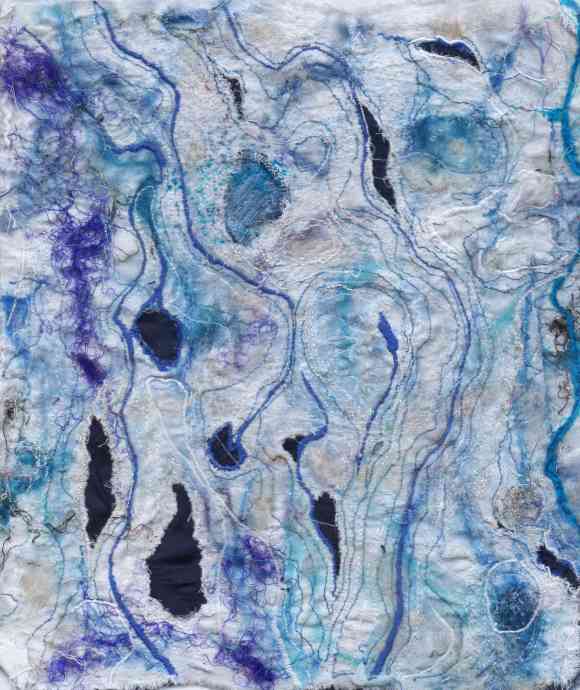
Making this I was inspired by Sarah Ross-Thompson, printmaker of renown and the photographs she often posts on Facebook.

“Rhythm in art is the visual or auditory pattern created by repeated shapes, elements, colors, sounds, and movements. It is used to create a sense of flow and connection within a work of art, as well as draw attention to certain areas of the composition. Rhythm can be achieved through repetition and variation, contrast, gradation and echo.” Studiobinder
Studiobinder – a video software house – blog has some useful definitions and practical examples of the creation and use of rhythm in video and they apply to plastic art (and other artistic ideas), most of the examples shown are painting but the same ideas apply everywhere.
In my own work I’m aware of rhythm in the flow of the stitch lines, the juxtaposition of colour and the textural depth, I use these as well as cut-away, embellish, embroider and ink. Mostly an intuitive process, based on the sketch and scrapbook but with larger pieces some planning and sketching is essential.

Working on fabric I usually have several pieces on the go, large and small. The smaller pieces sometimes get joined or incorporated into larger work.
This is an example of a series I called City, there are some larger and some smaller, framed and unframed.
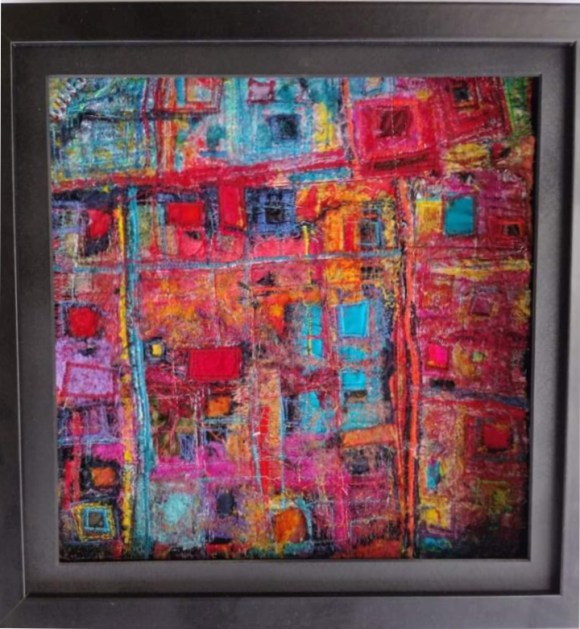
Part of an on-going study of colour.
 FlagFly