Categories
art

Textile experiments

The pleasure of textiles might be related to the fact we are literally surrounded by them from birth, almost instantly wrapped even before being presented to our mothers. A huge part of human endeavour is to clothe ourselves, keep us warm with bedding, cosseted with cushions. Decorative fabrics and upholstery play large parts in our lives and we expend a goodly portion of our income on all these things.

It’s thought that humans have been using clothing (skins) for at least 500,000 years but when we began decorating those clothes is not yet known. Decorative fabrics were used by ancient civilisations although examples are vanishingly rare, unlike clay pots they mostly cannot usually survive time.

The infinite possibilities of textile art offer a tempting panorama but in order to achieve anything it is necessary to restrict oneself to just a tiny fraction of that view, I think. I posted a little about making this piece last November and I haven’t found a use for it yet but I’m sure it will get used.
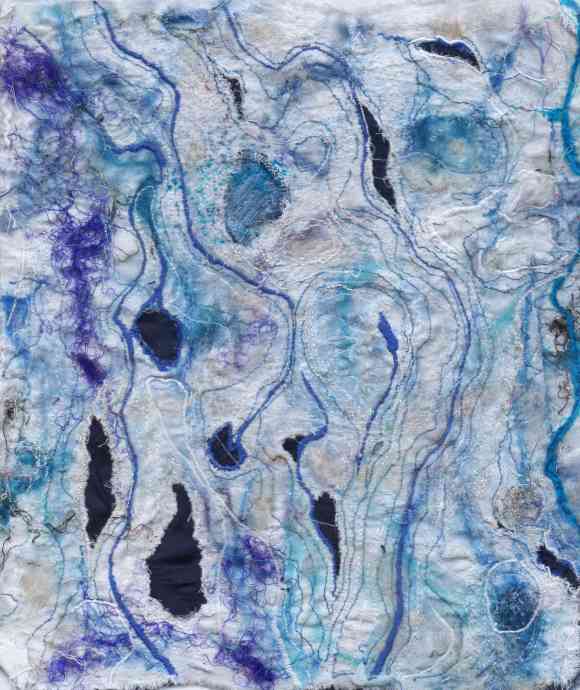
Pools, 26 x 21cm, mixed textiles embellished and stitched, 2024

Making this I was inspired by Sarah Ross-Thompson, printmaker of renown and the photographs she often posts on Facebook.

Collagraph print by Sarah Ross-Thompson
Categories
art

Rhythm

Rhythm in art is the visual or auditory pattern created by repeated shapes, elements, colors, sounds, and movements. It is used to create a sense of flow and connection within a work of art, as well as draw attention to certain areas of the composition. Rhythm can be achieved through repetition and variation, contrast, gradation and echo.” Studiobinder

Studiobinder – a video software house – blog has some useful definitions and practical examples of the creation and use of rhythm in video and they apply to plastic art (and other artistic ideas), most of the examples shown are painting but the same ideas apply everywhere.

In my own work I’m aware of rhythm in the flow of the stitch lines, the juxtaposition of colour and the textural depth, I use these as well as cut-away, embellish, embroider and ink. Mostly an intuitive process, based on the sketch and scrapbook but with larger pieces some planning and sketching is essential.

Work in progress

Categories
art

City

Working on fabric I usually have several pieces on the go, large and small. The smaller pieces sometimes get joined or incorporated into larger work.

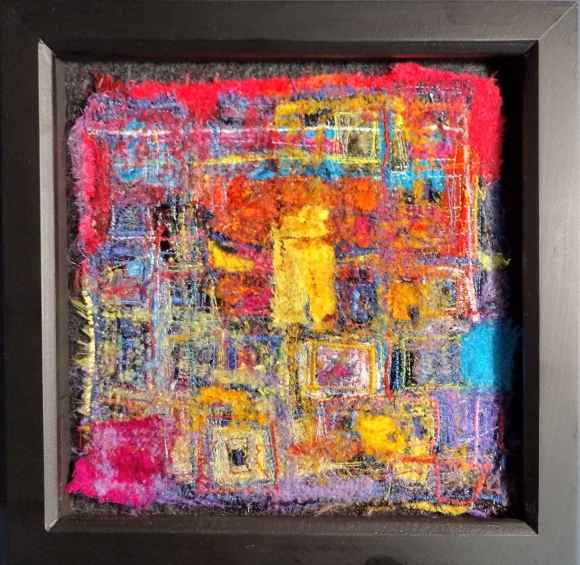
This is an example of a series I called City, there are some larger and some smaller, framed and unframed.

City – one of a series – 25 x 25 cm, mixed textiles embellished and stitched

Part of an on-going study of colour.

Categories
art

Requiem for Oil

Post updated October 8th 2024. This is the final version of Requiem for Oil, 270 x 165 cm, mixed textiles, lino-print, transfer & other print, stamping, ink, fabric paint, embroider and machine stitch. I delivered the quilt to 44AD gallery in Bath yesterday and it will be on display from Thursday 10th October as part of the Bath OPen Art Prize Exhibition 2024.

Art Brut (‘raw art’ or for the cupboard) I expect. But more influenced by the COBRA (Copenhagen, Brussels, Amsterdam) anti-formalism movement which grew out of Dada and the disaster of WW2.

If you’re in Amsterdam be sure to visit Cobra Museum in Amstelveen.

Requiem for Oil, artist’s book, 2016 (I updated the title)

I use a free font throughout the work, Action of the Time Now by Galdino Otten

Categories
art

Work in progress

Another in this series of textile pieces, not quite how I intended but almost finished and ready to frame. the contrast around the yellow isn’t as strong as I would like but further stitching over already quite dense and layered fabric and stitch will probably mean more broken sewing machine needles.

work in progress – City Sunrise, 25 x 25cm, mixed textiles, embellished and embroidered

Although most of the fabrics are plain colours I also use white and colour it in-situ, sometimes also colour white thread the same way.

Categories
art

Spring garden

Another machine embroidery and embellish piece, scraps of fabric, mostly natural cotton and silk but with some poly for the shine, this is rather more whimsical than most of my offerings, the bee seems to be popular but the wings need a bit more work.

Spring Garden with bee in progress, 34x34cm, mixed textiles, machine embroider and embellish.

I’ve been finding the dust from the machine embellishing process to be annoying, even using a mask it seems to get in the throat. I now have a small air filter machine that sits on the desk, it seems to help. I also vacuum every few minutes and make sure to wash hands often. The dust is very fine, it gathers around the embellishing needles and guard but also manages to spread around the work area.

Categories
art textiles

Charity shop textiles

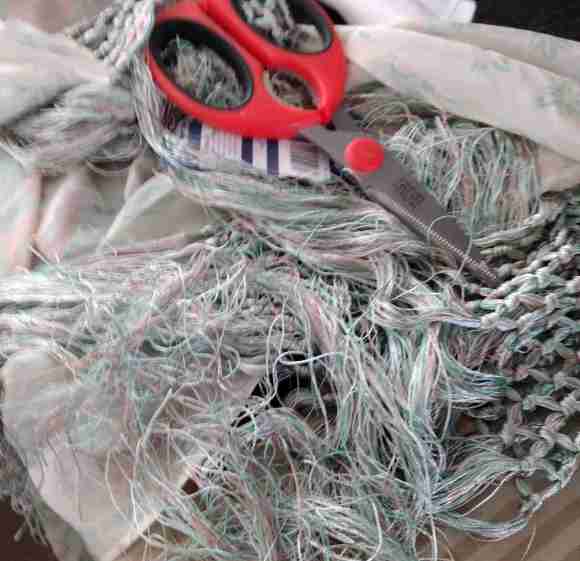
Now and then the UK charity shops are just amazing. I was browsing them this rainy morning in Bristol and found, in one shop four huge cotton scarfs in plain colours for just £2 each. Another one was just demanding to be used for doll-making, plaits and braids ready-made. All in good condition, as new. Now I’m reluctant to cut them!

Categories
art

City Sunset

Almost all the pieces in the Meltdown series are reworked from earlier fabric work, I don’t throw much away. I try to avoid polyester but for shine it does get into the mix. Rayon (viscose) thread and cloth can be shiny and I use that where I can, although rayon sewing thread is usually thinner and therefore weaker than cotton or polyester, I don’t know why that is. Silk is best but pure colour scraps can be hard to find. Viscose in clothing is often silky and now frequently used for fast-fashion clothing, also used in place of cotton, it was developed in the 19thC as a substitute for silk but has many other uses. Being made from wood pulp it’s potentially an organic fabric but the manufacturing process is intense and involves a number of chemicals. As with bamboo fabric – also viscose – there may be potential for a more environmentally friendly manufacturing process.

There’s a long way to go in creating truly eco-friendly fabrics but hopefully manufactures will be motivated by the prospect of reducing costs as well as saving the planet. Recycling of viscose clothing is low at present, a large amount go to landfill.

City Sunset, Mixed textiles, 20x20cm, 2024.

I was not planning to name the smaller pieces but this one seemed to name itself. All these works are for sale, at a range of modest prices direct from me or via Artigo, Gloucester Road, Bristol.

Categories
art

More in the Meltdown series

A larger-than-most piece in this series and one I’m happy with, scraps of fabric embellished and stitched, repeatedly. All the work in this series is heavily and repeatedly cut during the making, so as to expose layers of cloth and stitch. The deep box frame came with a rather wide mat/mount so I had a new one made barely 2cm wide. The black box seems to work well with these heavily textured pieces.

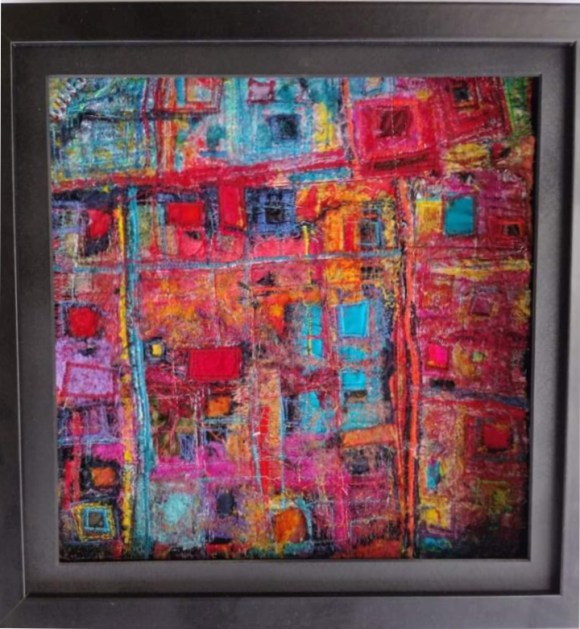
East Wind, Mixed textiles, 35 x 35 cm, 2024

As usual the pic doesn’t show the metallic threads or fabrics, or the stitch detail, much higher pixel count is needed for that. I was thinking about the convention in western visual art to read the work from upper left to lower right and how to try and challenge that in a small way. Keeping an idea in mind helps me focus on what I want the work to look like although I might not have a fully formed mental picture of the final result. The whole series could be described as abstract expressionism I think, if one needs labels, made trying to keep the emotion through colour to the fore. The East is Red (somewhat topical again) was in my mind while I was working on it.

Categories
art

Meltdown series on sale

Artigo, a lovely art gallery and shop on Gloucester Road, Bristol has a full set of my toy and model kits on sale and has a display of working samples which I’m told by proprietor Diego are popular with children and entertain them while adults are shopping.

Diego has kindly agreed to display for sale some of the textile art pieces I have loosely designated the Meltdown series. These are mostly quite small, colourful and heavily textured, I have named the larger pieces.

Artigo, 20.02.24

I’ve mounted these works in box frame without glass, as with impasto painting the texture is lost under glass. I used different sizes of mat at the front of the box frames (cut by Craftworks, Gloucester Rd, Bristol).