This construction toy is the largest I currently make and the only one I design and make that isn’t entirely 3mm plywood, in this case the sides are 1.5mm thick.
Greek Ship construction toy, 300mm long
High grade birch plywood gets more expensive as it gets thinner, a reflection of the manufacturing costs and the much smaller demand. This model has a working winch/anchor and is supplied with pva glue although this is not essential. I try to design models which are a good introduction to model-making and have some play value. All the models can be painted, acrylic is best and available from many low-cost shops.
Suitable for girls and boys over 3 years. On sale at Miller Toys and Models. There are 10 models to choose from and as the Corvid lockdown eases I’m hoping to add at least six more, manufacturing is not possible at the moment.
Some time ago I designed a shadow theatre and then laser cut a couple of them. But the design meant that there was a lot of waste plywood after the cut, and more problematically the dismantled theatre was bulky and not postal friendly. So I didn’t try selling it, other projects took precedence.
Recently someone contacted CATO Press, where I’m a member to say she was interested in shadow theatre, so I thought I would dust off the old design and try again.
To have some impact and to accommodate puppets a shadow theatre needs to be quite large, my first attempt was rather small. This time I started with the central idea that the structure would be fully demountable and would flat-pack to 700mm x 200mm or less with a pack thickness of less than 50mm. I would include a cloth screen and if possible a lamp of some sort, LED lamps make this a practical proposition, even a torch with a wide angle beam should work.
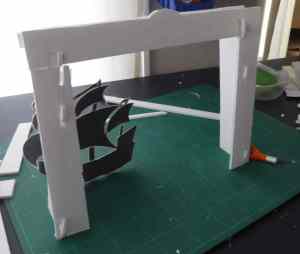
With the Corvid 19 lockdown on-going it is not possible to make laser cut prototypes, so I’ve made one in 5mm construction board, ½ size. The final version would be 3mm plywood. The slot-together pieces are not all shown, no screen and no decoration. Screen would attach by velcro, scenery to hang from cross-bars which slot into the tops of the wings, for quick change.
Shadow theatre mock-up 1/2 size
In the distant past I made quite large shadow theatres decorated with dragons etc. from construction board, but of course they don’t have a long life, unless treated very carefully. I used these working with adults with learning difficulties (a privilage) and had plenty of fun. It was often surprising to see who could project themselves into the puppets, and who struggled.
Puppets can be bought and one or two sites provided designs for free, Adventures In A Box is one, and these may be cut by hand, or with a vinyl cutter or stencil cutter. Making the sort of fabulous designs seen in traditional Indonesian shadow theatre is certain to demand time and skill, but far simpler things can be quite effective.
My new website – Miller Toys and Models – is up and running – thank you Bristol Web Design – and during the lockdown I have designed a further seven plywood models plus two variations and two steampunk(ish) models. But I haven’t been able to cut any of these because if my cutters at Basically Wooden are working they are working on protective equipment, not toys.
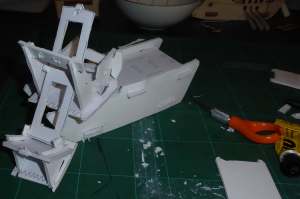
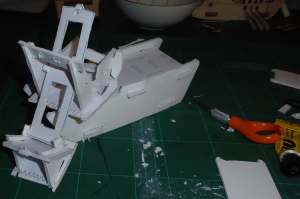
Dredger in construction boardPart of the instructions for assembly of the dredger model
Of course until I cut and assemble the prototypes I can’t go any further. There are always some errors in the design, no matter how much I check them on screen or make them in construction board. Construction board is soft and bends easily of course and so model parts can appear to fit when in fact they don’t.
On a positive note CATO Press in Easton, Bristol is reopening soon and I will be able to do some print making. Time to get some collagraph plates ready.
I recently joined the Urban Sketchers Bristol Facebook group and made a start with some images from the area I live in, Redfield. There are still a few chunky remnants of the railway age in this inner city area and the places near by although these are vanishing fast, converted into facades for new housing and other developments. Bristol University is planning a new campus alongside the side of the canal, not far from Temple Meads station.
But during the Corvid 19 lockdown (and the excellent weather) it is easy to go out early and do some sketching, take some snaps. No one around at 6 am and not much moving except the gulls pillaging the dumpers and fly tipped rubbish.
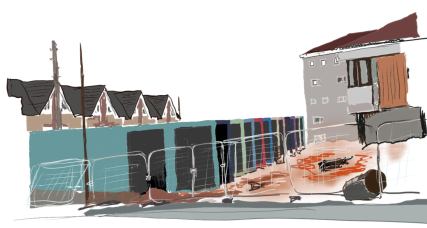
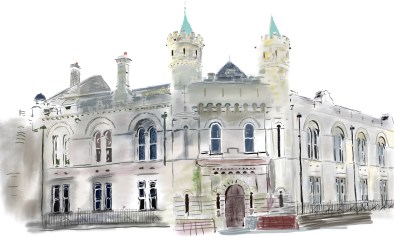
At Barton Hill SettlementSilverthorn Lane, Bristol
I’ve been working on several new models and now that we have lockdown for the foreseable future – in the UK anyway – I’m spending even more time on these. I’m lucky enough to have a (dry) studio at home. But the laser cutting at Basically Wooden in lovely Devon has stopped for now.
Cato Press (of which I am a member) is closed but some plate making can be done at home, especially for collagraph which only needs card and paste, at it’s most basic. Great examples at the Collagraph World Wide Facebook page.
“Today he may be sitting and rotting in an Israeli cell, but in 2012 Palestinian graphic designer Hafez Omar’s posters were setting the internet alight. On Facebook in particular, his simple, iconic, anonymous brown avatars in support of Palestinian prisoners held by Israel spread like wildfire. People all over social media changed their profile photos to one or other of the male or female versions.” Middle East Monitor.
The Student’s Struggle is Leading the Masses, Hafez Omar, Poster, 2012
Almost finished the owl doll, her costume is mainly silk embellished from scraps. The embellishing machine is great for using up even the tiniest of remnants and bits of thread. Embellishing needles get used up (broken) fairly quickly so I always keep a stock. Just a few final touches needed, her limbs and neck and around her face need to be darker .
I’m making another in a series of bird inspired dolls, this one is vaguely based on the Tawny Owl. Button jointed dolls are fairly easy to make, I always follow the pattern and instructions of Jan Horrox, a wonderful and inspiring doll maker, then modify things according to my wish. The most challenging part is to put a face onto the head.
Tawny Owl
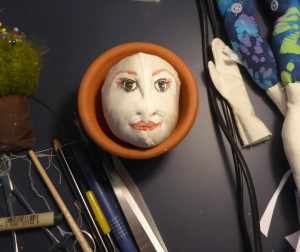
These dolls have needle sculpted faces, which takes some practice, then the features are drawn on with Micron pens and water-based coloured pencils. A steady hand is essential and the results can’t be guaranteed.
Doll head etc.
Once the face is drawn then it has to be sprayed with artist’s fix, the solvent type. These dolls are more ornamental than play, although I try to make them robust enough for older children. Next stage is to attach the head, then make hair, or in this case feathers of some sort.





 FlagFly