I’m still looking for varities of ships and boats to make into model kits. The dredger seemed interesting so I started with a basic hull, a shape I’ve now used many times and then added the dredger structure. The rotation was simply and the winch I’ve used before seemed to work but getting the bucket and the bucket arm to stay in place proved more difficult.
Dredger, approx 20cm
Above all I want the kit to be easy to assemble for a six year old and so any mechanism has to be as simple as possible. The kit also needs to fit onto four A5 sheets of 3mm plywood. Play value is also essential, my young testers check out this and other aspects of the design, especially it’s durability!
After some false starts I have used a living hinge and a cog arrangement on the bucket arm to rotate the bucket. The arm itself is also rotated with a similar cog winch but is held by a gravity pawl, giving just enough resistance.
This model will soon be available from Miller Toys and Models for just £18, 42 parts of press-out 3mm plywood, pva glue and string included.
The lockdown has proved to be a fruitful time for design, much less so for printmaking. Lovely CATO Press here in Easton, Bristol has re-opened but with strict social distancing, which means one person at a time can print; many of my fellow printmakers seem to be busy.
I have spent many hours getting several new models and their associated instructions, photos etc. to a stage where I might put them on my web site – Miller Toys and Models – and perhaps even sell a few. And I have at least five more in the development stage, just waiting for a few last tweaks.
Basically Wooden have been doing some laser cutting for me, in between their usual game boxes and face shields. They also have a new lampshade design which I really like, but it’s not on thir web site yet.
I try to design for ease of construction – the models are an introduction to wooden modelling aimed at younger children – as well as incorporating some playability, a degree of robustness and of course some eco-friendliness. 3Mm birch plywood is a wonderful material but the laser cutter has bought a whole new dimension to it.
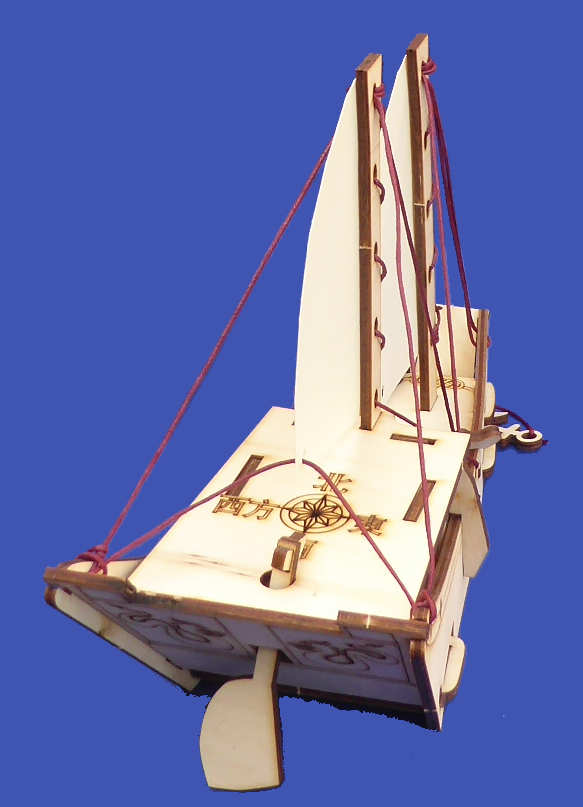
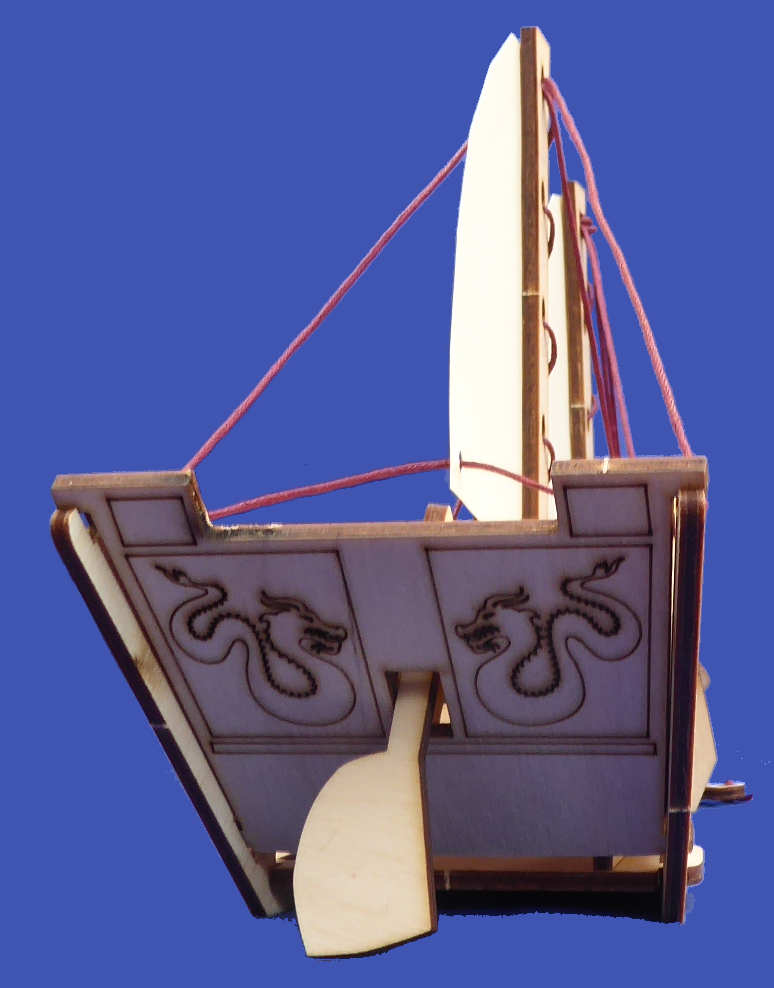
The first of my new models is a Chinese Junk, about 220 mm long, with a winch/anchor, linen paper sail and twine rigging.
A Junk is an ancient type of Chinese sailing ship, traditionally with fully battened sails, which are the bars running across the sail. This construction toy uses a schooner rig – one of many variants – for ease of assembly. The name Chinese Junk describes many types of coastal or river ships. They have been used as cargo ships, pleasure boats, or houseboats. They vary greatly in size and there are significant regional variations in the type of rig.
Junks were developed during the Song dynasty (960–1279) and were predominantly used by Chinese traders throughout Southeast Asia. They are still found, throughout Southeast Asia and India, but primarily in China. These days they are often used for pleasure sailing. (Thanks, Wikipedia).
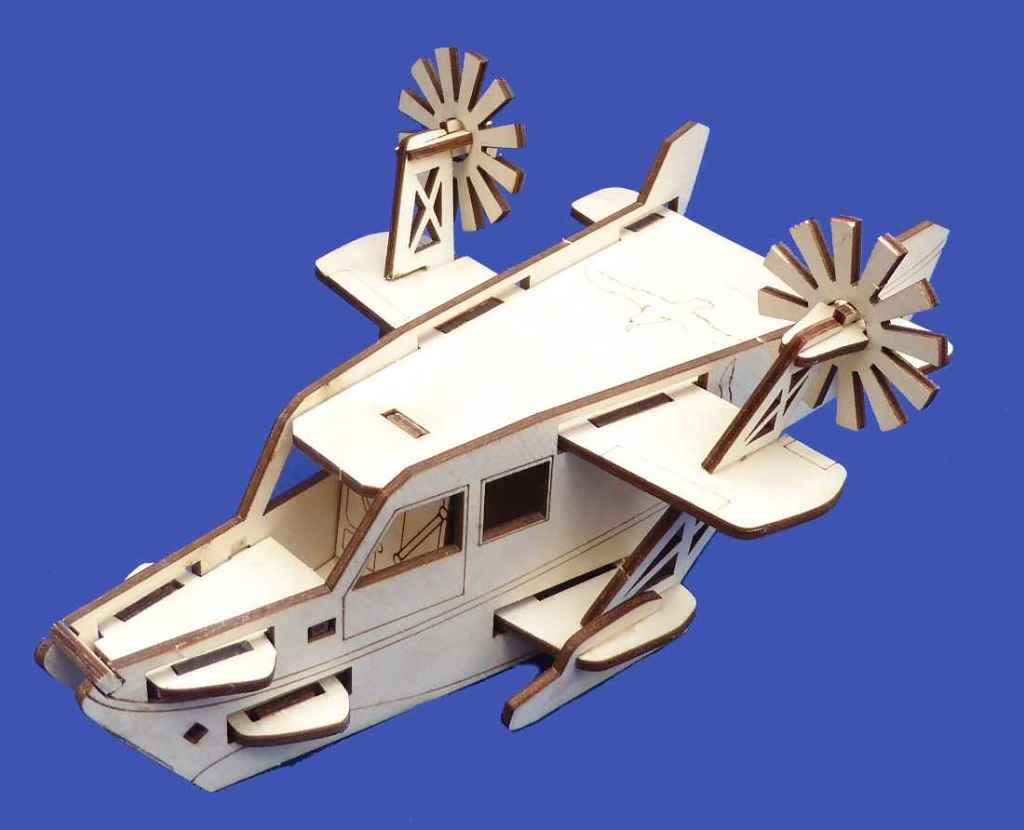
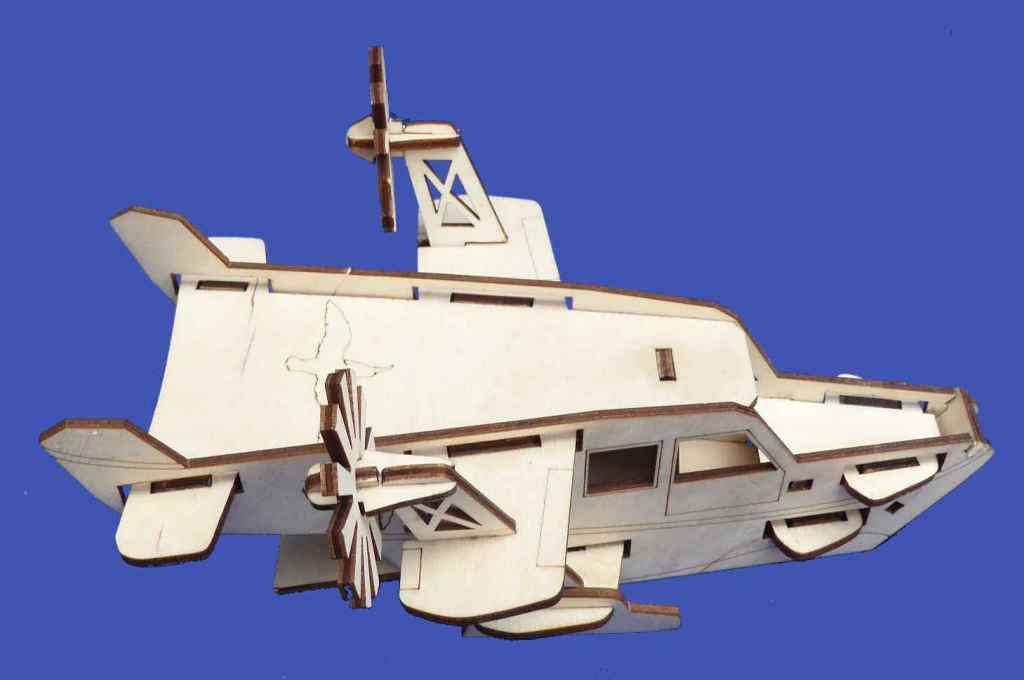
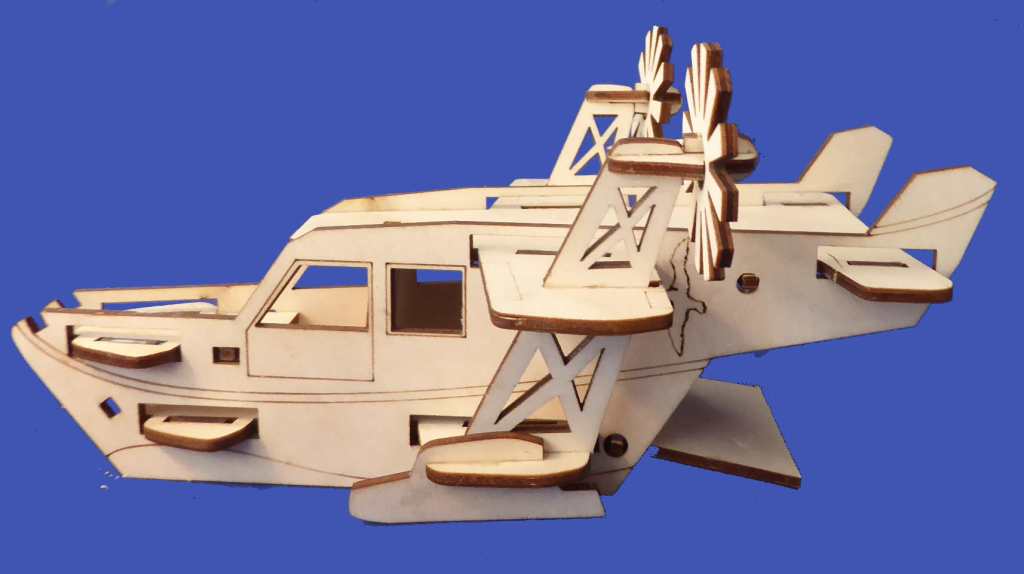
I have found aircraft designing to be difficult, they are so bland, all the same. But the long forgotten flying boat provided some inspiration. The early years of flying saw the creation of lots of flying boats, many with heavy lifting capabilities. Sadly few of the large and spectacular versions survived beyond the 1950s, although there are small ones in use, especially in Alaska. One giant of the 1940s was the famous Hughes H-4 Hercules , commonly known as the Spruce Goose, but actually made of birch, like my models. Only one – the largest flying boat ever – was built and it is still on display in Oregon, USA.
This construction toy flying boat is designed with cargo carrying in mind and so has a rear ramp door and twin propellers mounted high and to the rear. A small but versatile sea bird, and I like to think it could be a real flyer.
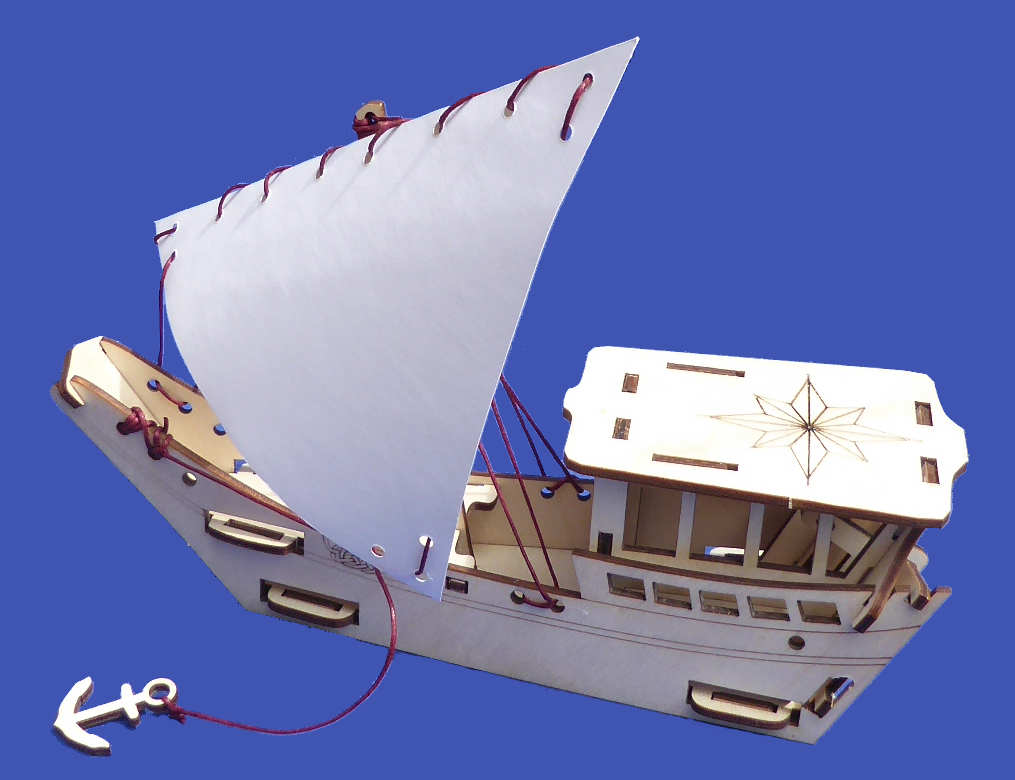
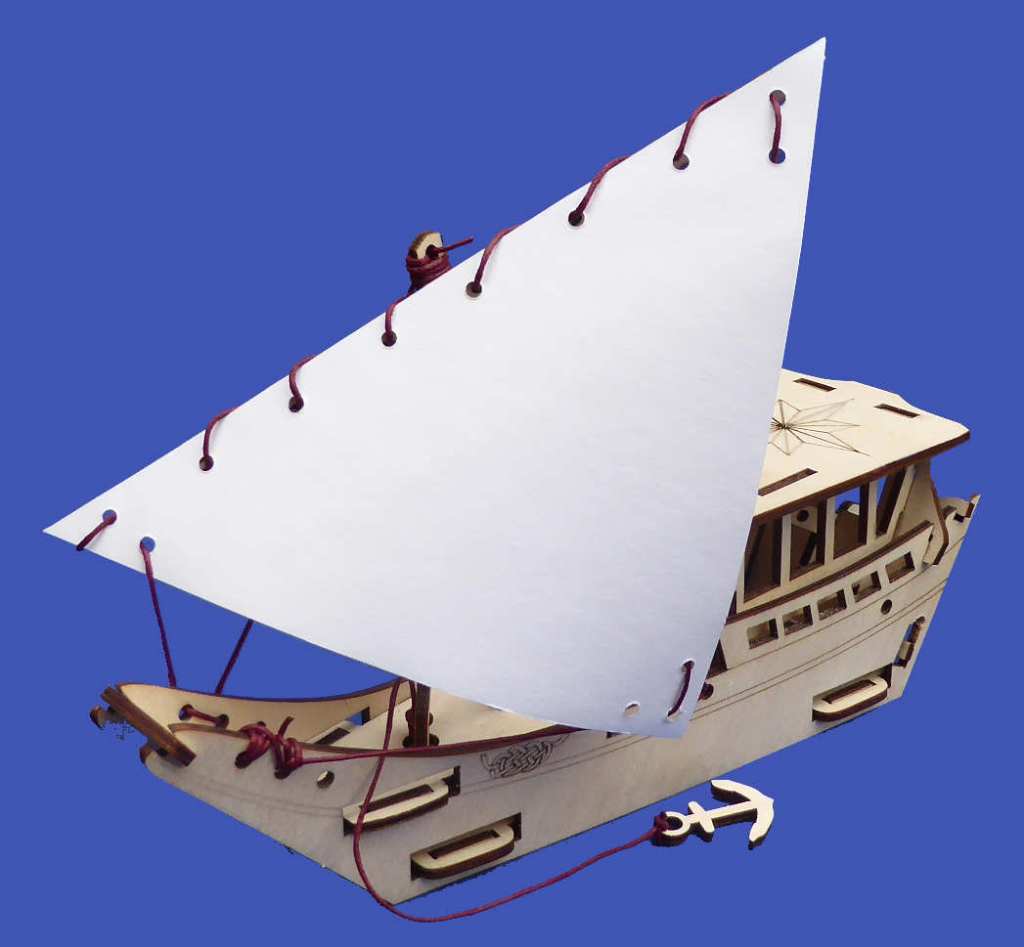
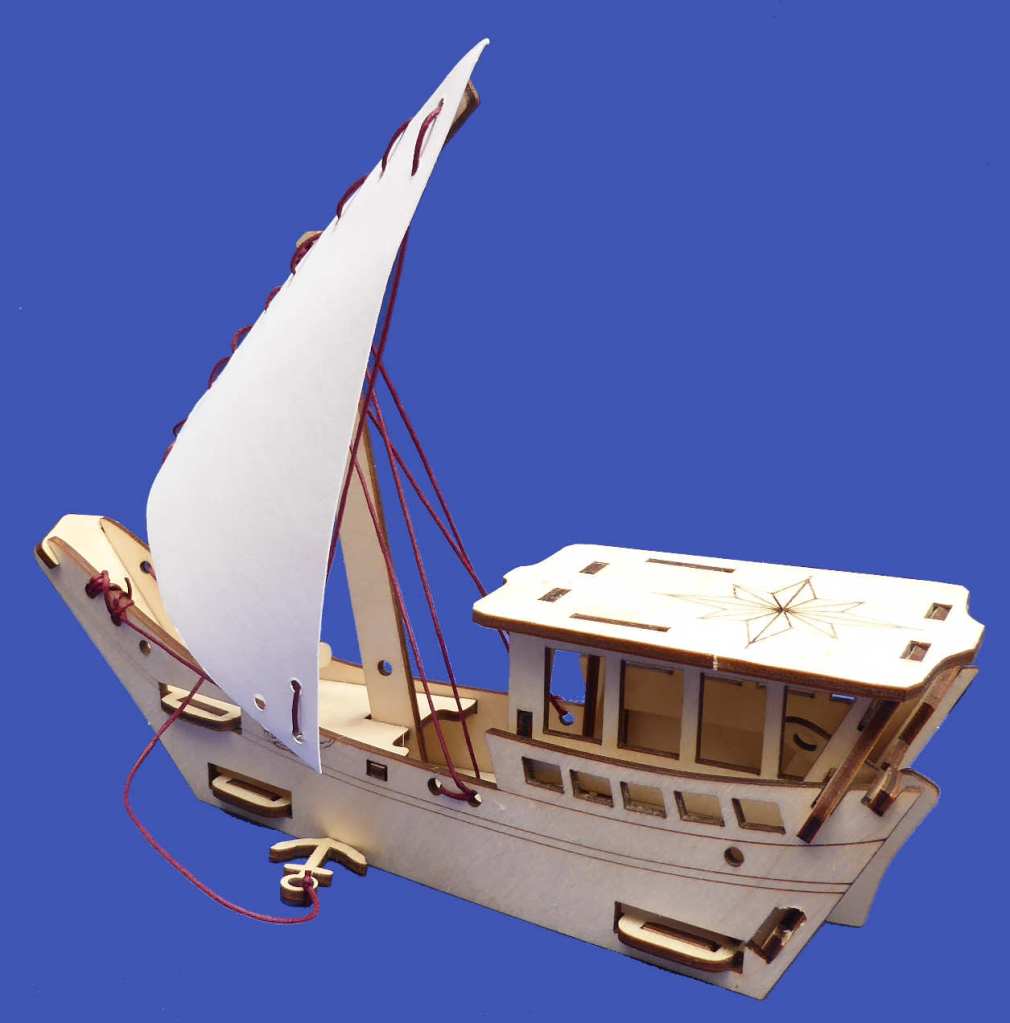
The third of the new models is an Arab Dhow, again about 220 mm long, with a winch/anchor and an opening stern door.
The beautiful, ancient trading craft of the Indian Ocean, Arabian Sea and the Red Sea, the dhow can still be seen and is used trade and tourism, for some fishing or just pleasure. It’s graceful lines attract the eye and the triangular lanteen sail is supported by a yard held at an angle across the boat.
There are many varieties of dhows, and they still carry dates, timber and fish, and tourists around the Persian Gulf, East Africa, Yemen and coastal South Asia (Pakistan, India, Bangladesh). Larger dhows have crews of approximately thirty, smaller ones typically around twelve.
I have used a waxed twine for the very simple rigging as it it is much easier to thread through the tiny holes than thin string. All three designs have some laser engraving, something I avoided on my earlier models (I was looking for clean lines and simplicity). All the models are ideal gifts for girls and boys over three and for any age, all materials and packaging is sustainable. On sale at Miller Toys and Models.
This is a style not usually associated with children’s toys or models, but my young testers were interested in my initial attempts so I have tried creating some construction toys in the genre, in 3mm laser-cut plywood.
Steampunk is sometimes described as retrofuturistic, a sub-genre of science fiction. It roots are in the cyberpunk novels of William Gibson, Bruce Willis and others, mixed with the gothic and scientific romance of Mary Shelly (Frankenstein), Jules Verne (Twenty Thousand Leagues Under the Sea) as well as more recent authors such as Michael Moorcock.
Twenty Thousand Leagues Under the Sea – A BBC illustration
Visually, the American steam locomotives and steamboats had an impact on some TV designers in the 1960s, and the artist Remedios Varo produced work that examined machinery and artefacts. But literary influences defined the genre in the west, while in Japan the manga comics were creating steampunk imagery from the 1940s onward, long before the term steampunk began to be used.
Manga comic, June 1940
The steam engine itself provides many of the most popular images, heavy iron, riveted plating, brass pipework, dials, valves, levers and obscure machinery. This is often combined, anachronistically with the imagery of the airship, a device which was thought to be the future of air transport at the beginning of the 20th Century. The games industry has created many of the most familiar images, with a wide range of styles in games such as Rise of Legends, Final Fantasy VI, The Chaos Engine et al.
Final Fantasy VI
No one ever powered a flying machine with a steam engine and it seems unlikely that anyone ever will, but it can be fun to imagine doing so. There are very few steampunk aeroplane drawings or models which look as if they might fly, those that do tend to be ‘diesel punk’ which allows for similar solidity and style but with far more apparent power.
There are some interesting steampunk helicopter designs on the web but as with the aeroplane designs many tend to use the gas bag or the jet engine to overcome the obvious visual discrepancies with apparent weight. Adding weapons is popular but is still more visual weight and it’s not something I would do.
Design for a model steampunk ‘copter – Chris Miller 2020
Plywood is not the most obvious material to use when trying to use the steampunk style, but the designer in me wants to rise to the challenge. I try to avoid the most cliched elements in my own steampunk designs – not always successfully – and to combine easy of assembly with good play value and hopefully something to attract children of all ages. I can’t get much cutting done at present due to the Corvid 19 lockdown but hopefully this will ease soon. My web site – Miller Toys and Models – will have new models as soon as possible.
This construction toy is the largest I currently make and the only one I design and make that isn’t entirely 3mm plywood, in this case the sides are 1.5mm thick.
Greek Ship construction toy, 300mm long
High grade birch plywood gets more expensive as it gets thinner, a reflection of the manufacturing costs and the much smaller demand. This model has a working winch/anchor and is supplied with pva glue although this is not essential. I try to design models which are a good introduction to model-making and have some play value. All the models can be painted, acrylic is best and available from many low-cost shops.
Suitable for girls and boys over 3 years. On sale at Miller Toys and Models. There are 10 models to choose from and as the Corvid lockdown eases I’m hoping to add at least six more, manufacturing is not possible at the moment.
Some time ago I designed a shadow theatre and then laser cut a couple of them. But the design meant that there was a lot of waste plywood after the cut, and more problematically the dismantled theatre was bulky and not postal friendly. So I didn’t try selling it, other projects took precedence.
Recently someone contacted CATO Press, where I’m a member to say she was interested in shadow theatre, so I thought I would dust off the old design and try again.
To have some impact and to accommodate puppets a shadow theatre needs to be quite large, my first attempt was rather small. This time I started with the central idea that the structure would be fully demountable and would flat-pack to 700mm x 200mm or less with a pack thickness of less than 50mm. I would include a cloth screen and if possible a lamp of some sort, LED lamps make this a practical proposition, even a torch with a wide angle beam should work.
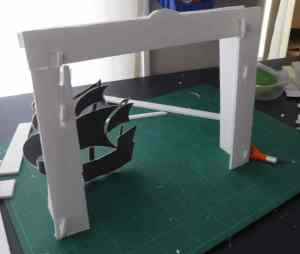
With the Corvid 19 lockdown on-going it is not possible to make laser cut prototypes, so I’ve made one in 5mm construction board, ½ size. The final version would be 3mm plywood. The slot-together pieces are not all shown, no screen and no decoration. Screen would attach by velcro, scenery to hang from cross-bars which slot into the tops of the wings, for quick change.
Shadow theatre mock-up 1/2 size
In the distant past I made quite large shadow theatres decorated with dragons etc. from construction board, but of course they don’t have a long life, unless treated very carefully. I used these working with adults with learning difficulties (a privilage) and had plenty of fun. It was often surprising to see who could project themselves into the puppets, and who struggled.
Puppets can be bought and one or two sites provided designs for free, Adventures In A Box is one, and these may be cut by hand, or with a vinyl cutter or stencil cutter. Making the sort of fabulous designs seen in traditional Indonesian shadow theatre is certain to demand time and skill, but far simpler things can be quite effective.
My new website – Miller Toys and Models – is up and running – thank you Bristol Web Design – and during the lockdown I have designed a further seven plywood models plus two variations and two steampunk(ish) models. But I haven’t been able to cut any of these because if my cutters at Basically Wooden are working they are working on protective equipment, not toys.
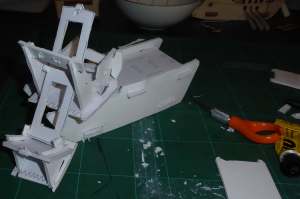
Dredger in construction board
Part of the instructions for assembly of the dredger model
Of course until I cut and assemble the prototypes I can’t go any further. There are always some errors in the design, no matter how much I check them on screen or make them in construction board. Construction board is soft and bends easily of course and so model parts can appear to fit when in fact they don’t.
On a positive note CATO Press in Easton, Bristol is reopening soon and I will be able to do some print making. Time to get some collagraph plates ready.
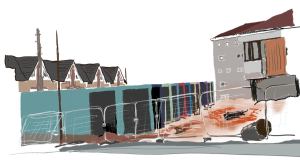
I recently joined the Urban Sketchers Bristol Facebook group and made a start with some images from the area I live in, Redfield. There are still a few chunky remnants of the railway age in this inner city area and the places near by although these are vanishing fast, converted into facades for new housing and other developments. Bristol University is planning a new campus alongside the side of the canal, not far from Temple Meads station.
But during the Corvid 19 lockdown (and the excellent weather) it is easy to go out early and do some sketching, take some snaps. No one around at 6 am and not much moving except the gulls pillaging the dumpers and fly tipped rubbish.
I’ve been working on several new models and now that we have lockdown for the foreseable future – in the UK anyway – I’m spending even more time on these. I’m lucky enough to have a (dry) studio at home. But the laser cutting at Basically Wooden in lovely Devon has stopped for now.
Cato Press (of which I am a member) is closed but some plate making can be done at home, especially for collagraph which only needs card and paste, at it’s most basic. Great examples at the Collagraph World Wide Facebook page.